Explain the general relationship between the muscles that flex and extend the wrist, including their location on the body.
Verified step by step guidance
1
Understand that flexion and extension are movements that occur at the wrist joint. Flexion refers to bending the wrist so the palm moves closer to the forearm, while extension refers to straightening the wrist so the back of the hand moves closer to the forearm.
Identify the muscles responsible for wrist flexion. These muscles are primarily located on the anterior (front) side of the forearm and include the flexor carpi radialis, flexor carpi ulnaris, and palmaris longus. These muscles originate from the medial epicondyle of the humerus and insert on the bones of the hand.
Identify the muscles responsible for wrist extension. These muscles are primarily located on the posterior (back) side of the forearm and include the extensor carpi radialis longus, extensor carpi radialis brevis, and extensor carpi ulnaris. These muscles originate from the lateral epicondyle of the humerus and insert on the bones of the hand.
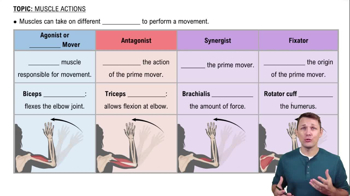
Understand the antagonistic relationship between these muscle groups. Flexor muscles contract to produce wrist flexion, while extensor muscles relax. Conversely, extensor muscles contract to produce wrist extension, while flexor muscles relax. This coordination allows smooth movement of the wrist.
Recognize the importance of these muscles in daily activities. Flexors and extensors work together to stabilize the wrist during tasks such as gripping, lifting, or typing, ensuring proper function and control of hand movements.
Verified video answer for a similar problem:
This video solution was recommended by our tutors as helpful for the problem above
Video duration:
4m
Play a video:
0 Comments
Key Concepts
Here are the essential concepts you must grasp in order to answer the question correctly.
Flexor Muscles
Flexor muscles are located on the anterior (front) side of the forearm and are responsible for bending the wrist and fingers. The primary flexor of the wrist is the flexor carpi radialis, which helps in flexing and abducting the wrist. Other important flexors include the flexor carpi ulnaris and the flexor digitorum muscles, which also contribute to finger flexion.
Extensor muscles are situated on the posterior (back) side of the forearm and are responsible for straightening the wrist and fingers. The main extensor of the wrist is the extensor carpi radialis longus, which aids in wrist extension and abduction. Other key extensors include the extensor carpi ulnaris and the extensor digitorum, which extend the fingers.
Antagonistic muscle action refers to the relationship between flexor and extensor muscles, where one muscle group contracts while the other relaxes to produce movement. For instance, when the flexor muscles contract to bend the wrist, the extensor muscles must relax to allow this motion. This coordinated action is essential for smooth and controlled movements of the wrist and hand.