Using what you have learned about changes in Gibbs free energy, would you predict the ∆G value of catabolic reactions to be positive or negative? What about anabolic reactions? Justify your answers using the terms 'enthalpy' and 'entropy.'
Verified step by step guidance
1
Understand that Gibbs free energy (∆G) is a measure of the spontaneity of a reaction, where a negative ∆G indicates a spontaneous process.
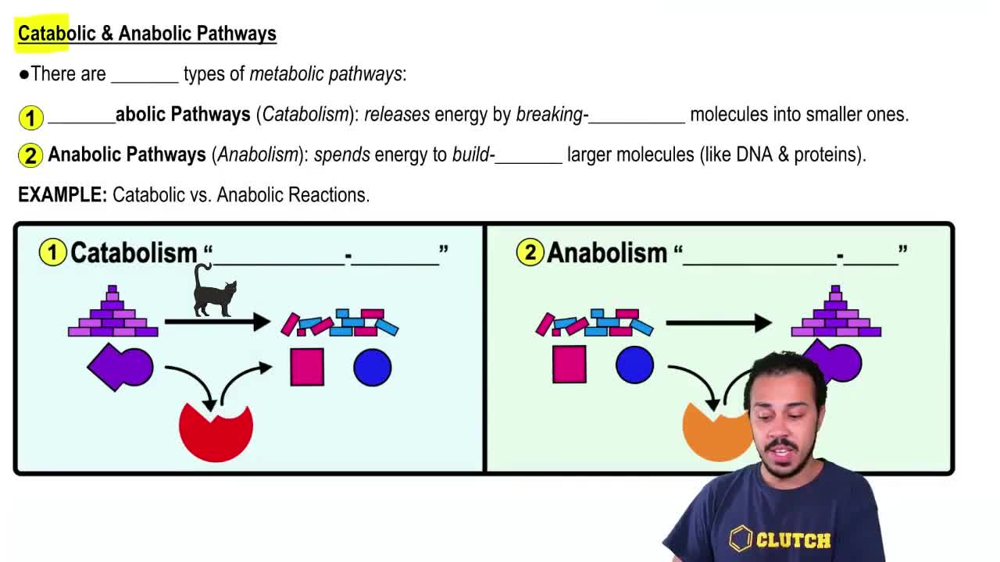
Recall that catabolic reactions involve the breakdown of complex molecules into simpler ones, often releasing energy.
Consider that in catabolic reactions, the enthalpy (∆H) typically decreases as bonds in complex molecules are broken, releasing energy.
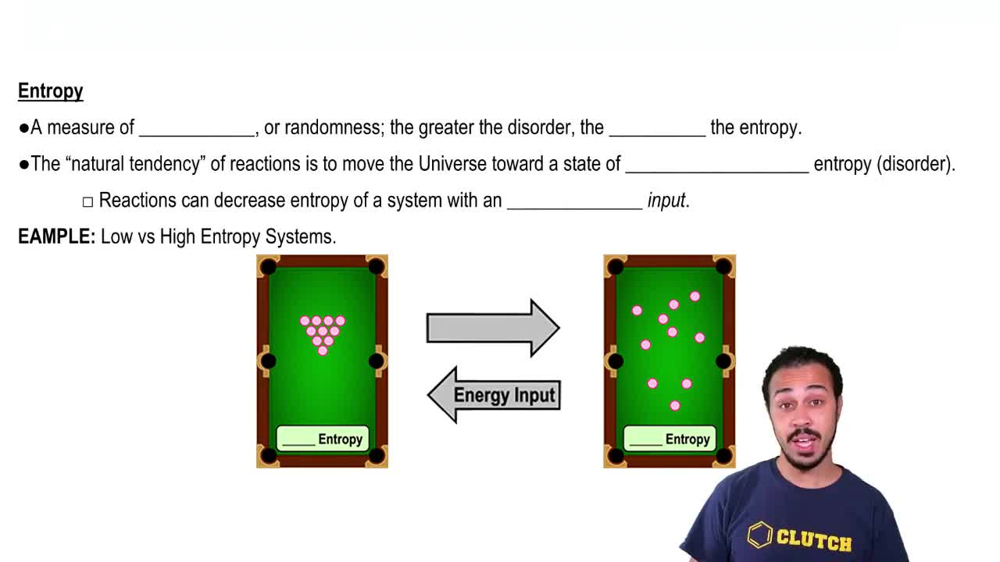
Recognize that catabolic reactions also tend to increase entropy (∆S) because they result in a greater number of simpler molecules, leading to more disorder.
Conclude that for catabolic reactions, the combination of decreased enthalpy and increased entropy generally results in a negative ∆G, indicating spontaneity. Conversely, anabolic reactions, which build complex molecules from simpler ones, usually have a positive ∆G due to increased enthalpy and decreased entropy.
Verified video answer for a similar problem:
This video solution was recommended by our tutors as helpful for the problem above
Video duration:
4m
Play a video:
0 Comments
Key Concepts
Here are the essential concepts you must grasp in order to answer the question correctly.
Gibbs Free Energy (∆G)
Gibbs free energy is a thermodynamic potential that measures the maximum reversible work obtainable from a thermodynamic system at constant temperature and pressure. A negative ∆G indicates that a reaction is spontaneous and can occur without external energy, while a positive ∆G suggests that the reaction is non-spontaneous and requires energy input.
Catabolic reactions involve the breakdown of complex molecules into simpler ones, releasing energy in the process, which typically results in a negative ∆G. In contrast, anabolic reactions build complex molecules from simpler ones, requiring energy input, and are characterized by a positive ∆G. Understanding these processes is crucial for predicting the energy dynamics of biological systems.
Enthalpy (H) refers to the total heat content of a system, while entropy (S) measures the degree of disorder or randomness in a system. The relationship between these two concepts is captured in the Gibbs free energy equation: ∆G = ∆H - T∆S. A reaction's spontaneity is influenced by changes in enthalpy and entropy, where favorable decreases in enthalpy or increases in entropy contribute to a negative ∆G.

 4:14 minutes
 Verified step by step guidance
 4:58
4:58