Match the bone markings listed on the right with their function listed on the left. 1. Attachment site for muscle or ligament 2. Forms a joint surface 3. Passageway for vessels or nerves c. Foramen
Verified step by step guidance
1
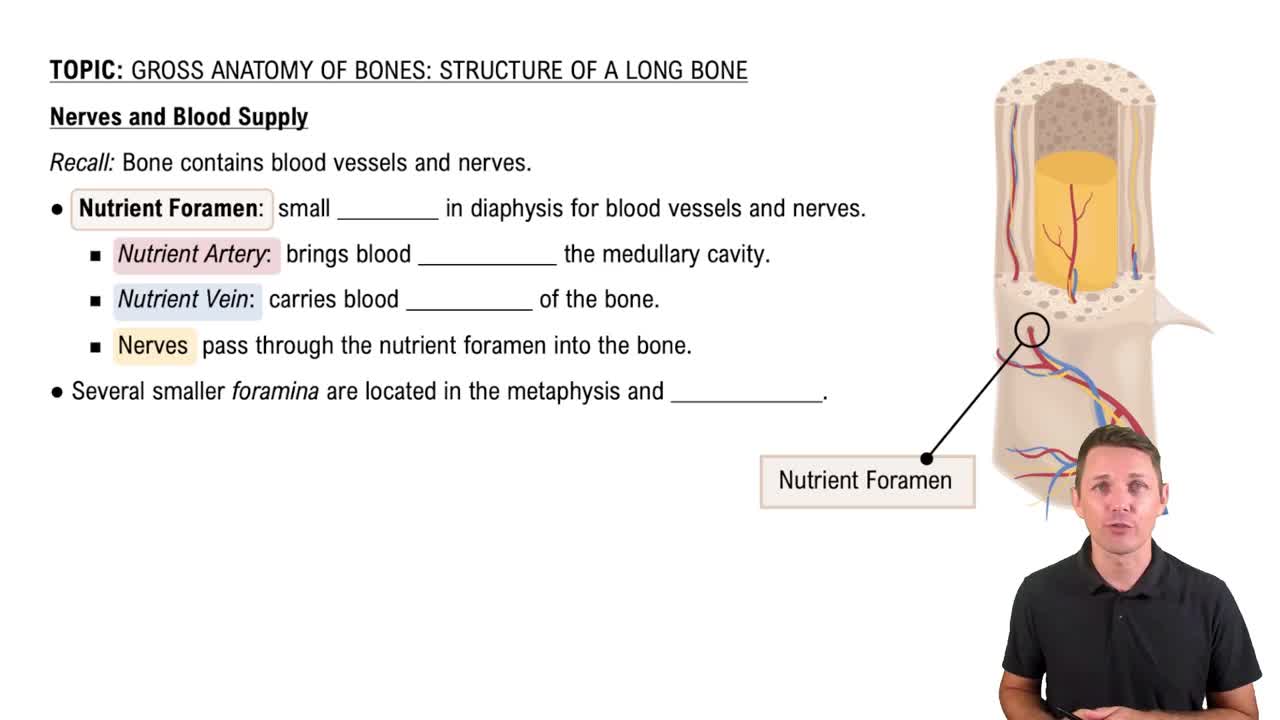
Step 1: Understand the function of a foramen. A foramen is an opening or hole in a bone that typically serves as a passageway for blood vessels, nerves, or other structures.
Step 2: Match the function of a foramen with the options provided. Since a foramen allows the passage of vessels or nerves, it corresponds to option 3: 'Passageway for vessels or nerves.'
Step 3: Eliminate the other options. A foramen does not serve as an attachment site for muscles or ligaments (option 1), nor does it form a joint surface (option 2).
Step 4: Confirm the correct match. The function of a foramen aligns exclusively with option 3: 'Passageway for vessels or nerves.'
Step 5: Finalize the answer by ensuring that the anatomical function of a foramen is correctly understood and matched to the appropriate description.
Verified video answer for a similar problem:
This video solution was recommended by our tutors as helpful for the problem above
Video duration:
1m
Play a video:
0 Comments
Key Concepts
Here are the essential concepts you must grasp in order to answer the question correctly.
Bone Markings
Bone markings are specific features on the surface of bones that serve various functions, such as attachment points for muscles and ligaments, joint formation, and pathways for nerves and blood vessels. Understanding these markings is crucial for identifying how bones interact with other structures in the body.
A foramen is an opening or hole in a bone that allows the passage of nerves and blood vessels. It is a type of bone marking that plays a vital role in the connectivity of the skeletal system with the nervous and circulatory systems, facilitating communication and transport.
Joint surfaces are the areas of bones that come into contact with each other to form joints. These surfaces are often smooth and covered with cartilage to reduce friction and allow for movement. Understanding joint surfaces is essential for comprehending how bones articulate and function together in the skeletal system.