You have discovered an enzyme that appears to function only when a particular sugar accumulates. Which of the following scenarios would you predict to be responsible for activating this enzyme?
a. The sugar cleaves the enzyme to form the active conformation.
b. The sugar is an allosteric regulatory molecule for the enzyme.
c. The sugar is a competitive inhibitor for the enzyme.
d. The sugar phosphorylates the enzyme to form the active conformation
Verified step by step guidance
1
insert step 1: Understand the role of enzymes and how they can be activated or inhibited. Enzymes are proteins that catalyze biochemical reactions, and their activity can be regulated by various mechanisms.
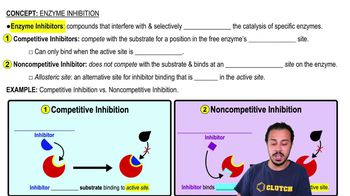
insert step 2: Consider the role of allosteric regulation. Allosteric regulation involves the binding of a molecule at a site other than the active site, which can change the enzyme's conformation and activity.
insert step 3: Evaluate the possibility of competitive inhibition. Competitive inhibitors bind to the active site of the enzyme, preventing the substrate from binding. This typically does not activate an enzyme.
insert step 4: Analyze the concept of enzyme cleavage. Some enzymes are activated by cleavage, which changes their conformation to an active form.
insert step 5: Consider phosphorylation as a regulatory mechanism. Phosphorylation involves the addition of a phosphate group, which can activate or deactivate enzymes by altering their conformation.
Verified video answer for a similar problem:
This video solution was recommended by our tutors as helpful for the problem above.
Video duration:
4m
Play a video:
0 Comments
Key Concepts
Here are the essential concepts you must grasp in order to answer the question correctly.
Enzyme Activation
Enzyme activation refers to the process by which an enzyme is converted from an inactive form to an active form, allowing it to catalyze reactions. This can occur through various mechanisms, including the binding of specific molecules that induce conformational changes in the enzyme structure, thereby enhancing its activity.
Allosteric regulation involves the binding of a molecule at a site other than the enzyme's active site, leading to a change in the enzyme's shape and function. Allosteric regulators can either enhance (activators) or inhibit (inhibitors) enzyme activity, providing a means of fine-tuning metabolic pathways in response to cellular conditions.
Competitive inhibition occurs when a molecule similar in structure to the substrate competes for binding at the active site of the enzyme. This type of inhibition can be overcome by increasing substrate concentration, as the inhibitor and substrate vie for the same binding site, ultimately affecting the overall rate of the enzymatic reaction.

 4:21 minutes
 Verified step by step guidance
 04:18
04:18