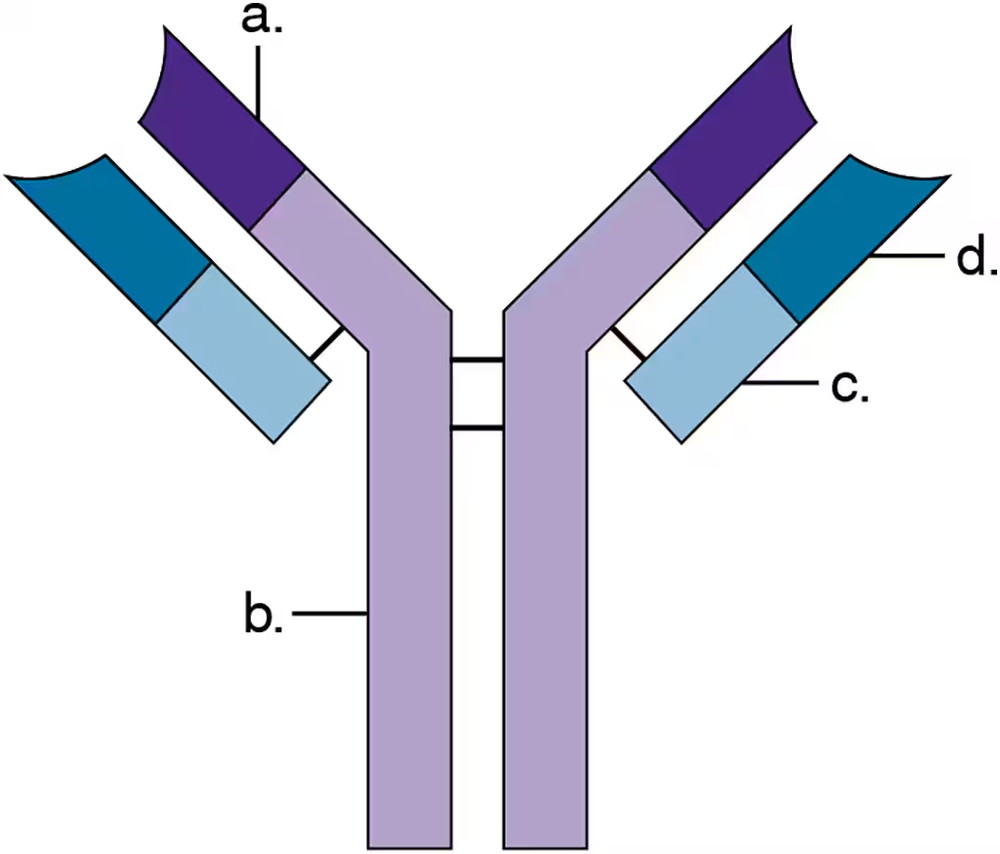
More than one choice may apply. Where exactly does an antigen bind to an antibody molecule?
Verified step by step guidance
1
Understand the structure of an antibody molecule: Antibodies are Y-shaped proteins composed of two heavy chains and two light chains. The tips of the Y-shaped structure contain regions called the variable regions, which are responsible for antigen binding.
Learn about the antigen-binding site: The antigen binds specifically to the variable region of the antibody. This region is highly specific and complementary to the shape of the antigen, allowing for precise binding.
Explore the concept of epitopes: Antigens have specific regions called epitopes, which are recognized and bound by the antibody's antigen-binding site. The binding occurs through non-covalent interactions such as hydrogen bonds, ionic bonds, and van der Waals forces.
Review the role of the Fab region: The Fab (Fragment antigen-binding) region of the antibody contains the variable regions of both the heavy and light chains. This is the part of the antibody that directly interacts with the antigen.
Consider the importance of specificity: The binding of an antigen to an antibody is highly specific due to the unique shape and chemical properties of the variable region. This specificity is crucial for the immune system to target and neutralize pathogens effectively.
Verified video answer for a similar problem:
This video solution was recommended by our tutors as helpful for the problem above
Video duration:
1m
Play a video:
0 Comments
Key Concepts
Here are the essential concepts you must grasp in order to answer the question correctly.
Antigen-Antibody Interaction
Antigens are foreign substances that trigger an immune response, while antibodies are proteins produced by the immune system to identify and neutralize these antigens. The specific region on the antigen that binds to an antibody is known as the epitope, which is crucial for the immune system's ability to recognize and respond to pathogens.
Antibodies have a unique structure that includes variable regions, which form the binding sites for antigens. These sites are highly specific, allowing antibodies to bind only to particular epitopes on antigens, leading to a precise immune response. Understanding the structure of antibodies is essential for comprehending how they interact with various antigens.
There are several classes of antibodies (IgG, IgM, IgA, IgE, and IgD), each with distinct functions and binding characteristics. For example, IgG is the most common antibody in blood and is crucial for long-term immunity, while IgM is the first antibody produced in response to an infection. Recognizing these differences helps in understanding how antibodies interact with antigens in various immune responses.