Table of contents
- 0. Review of College Algebra(0)
- 1. Measuring Angles(0)
- 2. Trigonometric Functions on Right Triangles(0)
- 3. Unit Circle(0)
- 4. Graphing Trigonometric Functions(0)
- 5. Inverse Trigonometric Functions and Basic Trigonometric Equations(0)
- 6. Trigonometric Identities and More Equations(0)
- 7. Non-Right Triangles(0)
- 8. Vectors(0)
- 9. Polar Equations(0)
- 10. Parametric Equations(0)
- 11. Graphing Complex Numbers(0)
- OLD 1. Angles and the Trigonometric Functions(0)
- OLD 2. Trigonometric Functions graphs, Inverse Trigonometric Functions(0)
- OLD 3. Trigonometric Identities and Equations (0)
- OLD 4. Laws of Sines, Cosines and Vectors(0)
- OLD 5. Complex Numbers, Polar Coordinates and Parametric Equations(0)
- NEW (not used) 7. Laws of Sines, Cosines and Vectors(0)
- NEW (not used) 8. Vectors(0)
- NEW(not used) 9. Polar equations(0)
- NEW (not used) 11. Graphing Complex Numbers(0)
4. Graphing Trigonometric Functions
Graphs of the Sine and Cosine Functions
4. Graphing Trigonometric Functions
Graphs of the Sine and Cosine Functions: Videos & Practice Problems
61 of 0
Problem 61Multiple Choice
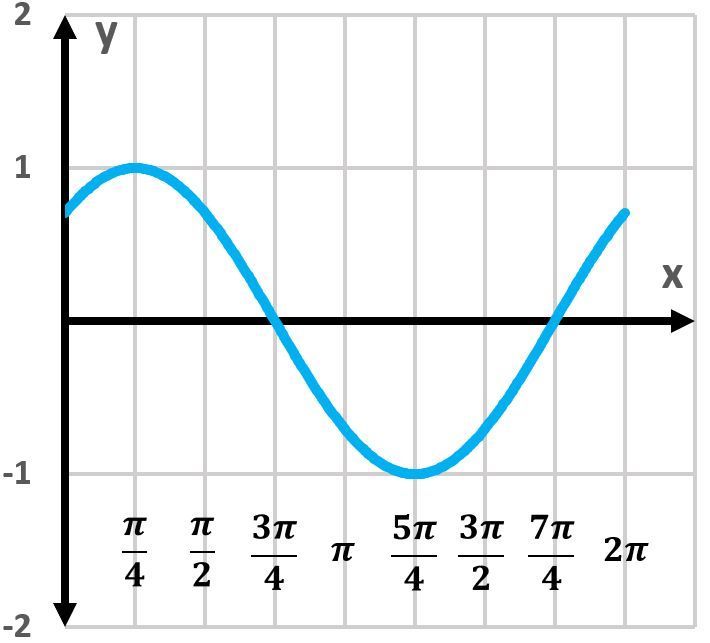
If the trigonometric function shown has the possible forms of y=d+sinx, y=d+cosx, y=sin(x−c), or y=cos(x−c), what is the equation that represents the graph? Note that c should have the smallest possible positive value.

0 Comments