Identify the quadrant (or possible quadrants) of an angle θ that satisfies the given conditions. See Example 3. cos θ > 0 , sec θ > 0
Ch. 1 - Trigonometric Functions
Chapter 2, Problem 39
Concept Check Classify each triangle as acute, right, or obtuse. Also classify each as equilateral, isosceles, or scalene. See the discussion following Example 2.
Verified step by step guidance1
Identify the measures of the angles in the triangle. If the problem provides side lengths, use the Law of Cosines to find the angles. The Law of Cosines formula is: \(c^2 = a^2 + b^2 - 2ab \cos(C)\), where \(C\) is the angle opposite side \(c\).
Classify the triangle by its angles: if all angles are less than 90°, it is an acute triangle; if one angle is exactly 90°, it is a right triangle; if one angle is greater than 90°, it is an obtuse triangle.
Classify the triangle by its sides: if all three sides are equal, it is equilateral; if exactly two sides are equal, it is isosceles; if all sides are different lengths, it is scalene.
To verify side equality, compare the given side lengths directly. If only angles are given, use the Law of Sines or Law of Cosines to find side lengths if needed.
Summarize your classification by combining the angle-based and side-based categories, for example, 'acute isosceles' or 'right scalene'.

Verified video answer for a similar problem:
This video solution was recommended by our tutors as helpful for the problem above.
Video duration:
1mWas this helpful?
Key Concepts
Here are the essential concepts you must grasp in order to answer the question correctly.
Classification of Triangles by Angles
Triangles are classified based on their angles into acute (all angles less than 90°), right (one angle exactly 90°), or obtuse (one angle greater than 90°). Understanding these categories helps determine the triangle's shape and properties.
Recommended video:
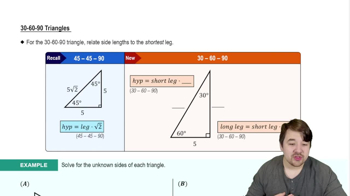
30-60-90 Triangles
Classification of Triangles by Sides
Triangles are also classified by side lengths as equilateral (all sides equal), isosceles (two sides equal), or scalene (all sides different). This classification provides insight into the triangle's symmetry and side relationships.
Recommended video:
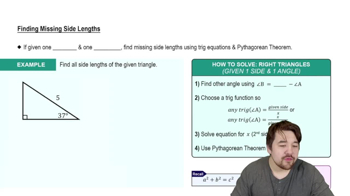
Finding Missing Side Lengths
Relationship Between Angles and Sides in Triangles
The size of a triangle's angles is related to the lengths of its sides: larger sides face larger angles. This principle helps in identifying the triangle type when given side lengths or angles, aiding in accurate classification.
Recommended video:
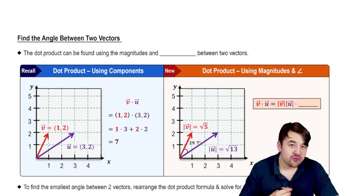
Find the Angle Between Vectors
Related Practice
Textbook Question
1176
views
Textbook Question
Give all six trigonometric function values for each angle θ . Rationalize denominators when applicable.
cos θ = ―5/8 , and θ is in quadrant III
938
views
Textbook Question
Concept Check Suppose that the point (x, y) is in the indicated quadrant. Determine whether the given ratio is positive or negative. Recall that r = √(x² + y²) .(Hint: Drawing a sketch may help.) IV , x/r
585
views
Textbook Question
Find the measure of the smaller angle formed by the hands of a clock at the following times. 8:20
712
views
Textbook Question
Perform each calculation. See Example 3. 75° 15' + 83° 32'
548
views
Textbook Question
Concept Check Suppose that the point (x, y) is in the indicated quadrant. Determine whether the given ratio is positive or negative. Recall that r = √(x² + y²) .(Hint: Drawing a sketch may help.) II , y/x
555
views