
Ch. 1 - Introduction to Statistics
Triola - Elementary Statistics 14th Edition
Triola14th EditionElementary StatisticsISBN: 9780137366446Not the one you use?Change textbook
Chapter 1, Problem 1.2.6

In Exercises 5–12, identify whether the given value is a statistic or a parameter.
Drivers According to the Federal Highway Administration, there are 212 million licensed drivers in the United States.

Verified step by step guidance
1
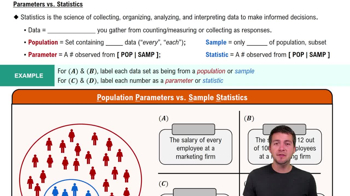
Understand the difference between a statistic and a parameter. A statistic is a numerical value that describes a sample, while a parameter is a numerical value that describes a population.
Identify the context of the given value. The problem states that there are 212 million licensed drivers in the United States.
Determine whether the value represents a sample or the entire population. In this case, the value refers to all licensed drivers in the United States, which is the entire population.
Since the value describes the entire population, it is considered a parameter.
Conclude that the given value of 212 million licensed drivers is a parameter because it represents a characteristic of the entire population of drivers in the United States.

Verified video answer for a similar problem:

This video solution was recommended by our tutors as helpful for the problem above.
Video duration:
1m
Was this helpful?

Key Concepts

Here are the essential concepts you must grasp in order to answer the question correctly.

Statistic

A statistic is a numerical value that describes a characteristic of a sample, which is a subset of a larger population. It is used to estimate or infer properties about the population from which the sample is drawn. For example, if a survey of 1,000 drivers finds that 60% support a new traffic law, this percentage is a statistic.
Recommended video:
Guided course
05:53
Parameters vs. Statistics

Parameter

A parameter is a numerical value that describes a characteristic of an entire population. It is a fixed value that is usually unknown and can only be estimated through statistics derived from samples. In the context of the question, the total number of licensed drivers in the U.S. is a parameter because it refers to the entire population of drivers.
Recommended video:
Guided course
05:53
Parameters vs. Statistics

Population vs. Sample

In statistics, a population includes all members of a specified group, while a sample is a subset of that population selected for analysis. Understanding the distinction is crucial for determining whether a value is a statistic or a parameter. In the given example, the 212 million licensed drivers represent the entire population, not a sample.
Recommended video:
05:11
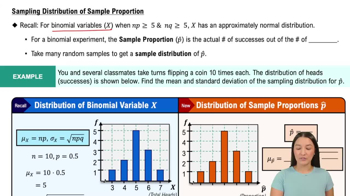
Sampling Distribution of Sample Proportion
Related Practice
Textbook Question

In Exercises 9–20, identify which of these types of sampling is used: random, systematic, convenience, stratified, or cluster.

Criminology Researchers randomly selected 50 convicted felons from each category of burglary, auto theft, and assault.

325
views
Textbook Question

In Exercises 29–32, indicate whether the observational study used is cross-sectional, retrospective, or prospective.

Marijuana Study Researchers from the National Institutes of Health want to determine the current rates of marijuana consumption among adults living in states that have legalized the use of marijuana. They conduct a survey of 500 adults in those states.

272
views
Textbook Question

In Exercises 9–20, identify which of these types of sampling is used: random, systematic, convenience, stratified, or cluster.

Highway Strength The New York State Department of Transportation evaluated the quality of the New York State Thruway by testing core samples collected at regular intervals of 1 mile.

308
views
Textbook Question

In Exercises 29–32, indicate whether the observational study used is cross-sectional, retrospective, or prospective.

Heart Health Study Samples of subjects with and without heart disease were selected, and then researchers looked back in time to determine whether they took aspirin on a regular basis.

274
views
Textbook Question

In Exercises 33–36, identify which of these designs is most appropriate for the given experiment: completely randomized design, randomized block design, or matched pairs design.


West Nile Vaccine Currently, there is no approved vaccine for the prevention of infection by West Nile virus. A clinical trial of a possible vaccine is being planned to include subjects treated with the vaccine while other subjects are given a placebo.

287
views
Textbook Question

In Exercises 13–20, determine whether the results appear to have statistical significance, and also determine whether the results appear to have practical significance.


Election Fraud The County Clerk in Essex County, New Jersey, was responsible for randomly assigning the order in which candidates’ names appeared on a recent election ballot. Among 41 different ballots, a Democrat was placed on the first line 40 times, and a Republican was placed on the first line once.

259
views