
Ch. 1 - Introduction to Statistics
Triola - Elementary Statistics 14th Edition
Triola14th EditionElementary StatisticsISBN: 9780137366446Not the one you use?Change textbook
Chapter 1, Problem 1.3.25

In Exercises 21–28, determine whether the study is an experiment or an observational study, and then identify a major problem with the study.
Sleep Study When designing the study of a new treatment for insomnia in adults, researchers were criticized because their test subjects consisted of 75 college students. They then expanded the study so that 750 college students were given the treatment.

Verified step by step guidance
1
Identify the type of study: Determine if the study is an experiment or an observational study. An experiment involves the manipulation of variables to observe effects, while an observational study involves observing subjects without intervention.
Assess the study design: In this case, the study involves giving a treatment to a group of subjects, which indicates that it is an experiment since the researchers are actively applying a treatment to observe its effects.
Evaluate the sample selection: Consider the characteristics of the sample used in the study. Here, the sample consists entirely of college students, which may not be representative of the general adult population with insomnia.
Identify potential biases: Recognize that using only college students can introduce selection bias, as this group may not accurately reflect the diversity of the adult population in terms of age, lifestyle, and other factors that could affect insomnia.
Suggest improvements: Propose ways to address the identified problem, such as expanding the sample to include a more diverse range of adults from different age groups and backgrounds to improve the generalizability of the study results.

Verified video answer for a similar problem:

This video solution was recommended by our tutors as helpful for the problem above.
Video duration:
4m
Was this helpful?

Key Concepts

Here are the essential concepts you must grasp in order to answer the question correctly.

Experimental vs. Observational Study

An experimental study involves the manipulation of variables to determine cause-and-effect relationships, while an observational study observes subjects without intervention. In the sleep study, the researchers applied a treatment to the subjects, indicating it is an experimental study.
Recommended video:
Guided course
04:39
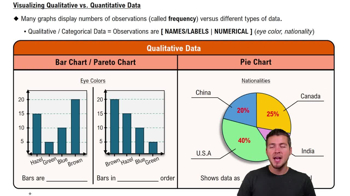
Visualizing Qualitative vs. Quantitative Data

Sample Size and Generalizability

Sample size refers to the number of participants in a study, which can affect the reliability of the results. The concern in this study arises from the fact that the sample consisted solely of college students, which may limit the generalizability of the findings to the broader population of adults suffering from insomnia.
Recommended video:
05:11
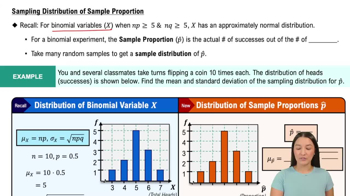
Sampling Distribution of Sample Proportion

Selection Bias

Selection bias occurs when the participants included in a study are not representative of the larger population, potentially skewing results. In this case, using only college students may introduce selection bias, as their sleep patterns and responses to treatment may differ significantly from those of older adults or individuals with varying lifestyles.
Recommended video:
04:06
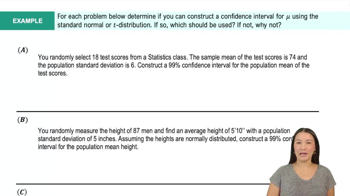
Critical Values: t-Distribution Example 1
Related Practice
Textbook Question

Directions in Degrees Standard navigation systems used for aviation and boating are based on directions measured in degrees, with north represented by 0° Relative to north, east is 90°, south is 180°, and west is 270°. What is the level of measurement of such directions measured in degrees?

269
views
Textbook Question

In Exercises 37–44, answer the given questions, which are related to percentages.

Percentages in Advertising An ad for Big Skinny wallets included the statement that one of their wallets “reduces your filled wallet size by 50%–200%.” What is wrong with this statement?

267
views
Textbook Question

In Exercises 13–20, determine whether the results appear to have statistical significance, and also determine whether the results appear to have practical significance.


Bias in Jury Selection In the case of Casteneda v. Partida, it was found that during a period of 11 years in Hidalgo County, Texas, 870 people were selected for grand jury duty, and 39% of them were Americans of Mexican ancestry. Among the people eligible for grand jury duty, 79.1% were Americans of Mexican ancestry.

306
views
Textbook Question

In Exercises 29–36, identify what is wrong.

Healthy Water In a USA Today online poll, 951 Internet users chose to respond, and 57% of them said that they prefer drinking bottled water instead of tap water.

279
views
Textbook Question

In Exercises 21–28, determine which of the four levels of measurement (nominal, ordinal, interval, ratio) best describes the given data.

Criminology In a criminology study, the lengths of prison sentences are obtained for randomly selected subjects convicted of auto theft.

371
views
Textbook Question

In Exercises 21–24, refer to the sample of body temperatures (degrees Fahrenheit) in the table below. (The body temperatures are from Data Set 5 in Appendix B.)

[IMAGE]

Conclusion If we analyze the listed body temperatures with suitable methods of statistics, we conclude that when the differences are found between the 8 AM body temperatures and the 12 AM body temperatures, there is a 64% chance that the differences can be explained by random results obtained from populations that have the same 8 AM and 12 AM body temperatures. What should we conclude about the statistical significance of those differences?

298
views