
Ch. 1 - Introduction to Statistics
Triola - Elementary Statistics 14th Edition
Triola14th EditionElementary StatisticsISBN: 9780137366446Not the one you use?Change textbook
Chapter 1, Problem 1.3.23

In Exercises 21–28, determine whether the study is an experiment or an observational study, and then identify a major problem with the study.
Drinking and Driving A researcher for a consortium of insurance companies plans to test for the effects of drinking on driving ability by randomly selecting 1000 drivers and then randomly assigning them to two groups: One group of 500 will drive in New York City after no alcohol consumption, and the second group will drive in New York City after consuming three shots of Jim Beam bourbon whiskey.

Verified step by step guidance
1
Identify the type of study: Determine if the study involves manipulation of variables or merely observation. In this case, the researcher is assigning participants to different conditions (alcohol consumption vs. no alcohol consumption), which indicates an experiment.
Define the independent and dependent variables: The independent variable is the alcohol consumption (no alcohol vs. three shots of whiskey), and the dependent variable is the driving ability.
Consider ethical implications: Evaluate whether the study design poses any ethical concerns, such as the safety of participants and others, given that driving under the influence is illegal and dangerous.
Assess the validity of the study: Consider if the study design allows for a valid conclusion about the effect of alcohol on driving ability. The random assignment helps control for confounding variables, but ethical concerns may invalidate the study.
Identify a major problem: The primary issue with this study is the ethical concern of having participants drive under the influence, which poses significant risks to their safety and the safety of others.

Verified video answer for a similar problem:

This video solution was recommended by our tutors as helpful for the problem above.
Video duration:
3m
Was this helpful?

Key Concepts

Here are the essential concepts you must grasp in order to answer the question correctly.

Experimental Study

An experimental study involves the manipulation of one or more independent variables to observe the effect on a dependent variable. In this context, the researcher assigns participants to different conditions (sober vs. intoxicated driving) to directly assess the impact of alcohol on driving ability. This design allows for causal inferences about the relationship between drinking and driving performance.
Recommended video:
5:37
Introduction to Probability

Observational Study

An observational study, in contrast, does not involve manipulation of variables; instead, researchers observe and measure outcomes without intervention. This type of study is useful for identifying correlations but cannot establish causation. Understanding the difference is crucial for evaluating the validity of the research findings in the context of the question.
Recommended video:
Guided course
04:39
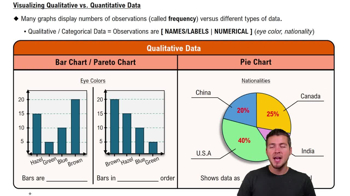
Visualizing Qualitative vs. Quantitative Data

Random Assignment

Random assignment is a technique used in experimental studies to ensure that each participant has an equal chance of being assigned to any group. This process helps eliminate bias and confounding variables, making the groups comparable. In the given study, random assignment is employed to divide drivers into sober and intoxicated groups, which strengthens the reliability of the results.
Recommended video:
Guided course
07:09
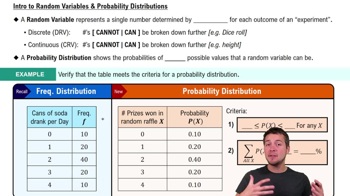
Intro to Random Variables & Probability Distributions
Related Practice
Textbook Question

In Exercises 21–28, determine which of the four levels of measurement (nominal, ordinal, interval, ratio) best describes the given data.

College Students In order to better plan for the incoming freshman class, a college dean asks each newly admitted student to identify their likely major (physics, business, math, psychology, engineering, law, etc.).

456
views
Textbook Question

Body Temperature The given expression is used for determining the likelihood that the average (mean) human body temperature is different from the value of 98.6°F that is commonly used. Find the given value and round the result to two decimal places.


(98.2 - 98.6) / (0.62 / sqrt(106) )

303
views
Textbook Question

In Exercises 37–44, answer the given questions, which are related to percentages.

Percentages in Advertising In an actual ad for the Club, a device used to discourage car thefts, it was stated that “The Club reduces your odds of car theft by 400%.” What is wrong with this statement?

319
views
Textbook Question

Discrete/Continuous Data Which of the following describe discrete data?


a. The exact heights of all NBA basketball players

463
views
Textbook Question

IQ Scores Listed below are the IQ scores of randomly selected statistics professors. What value is obtained when those IQ scores are added and the total is divided by the number of scores? (This result, called the mean, is discussed in Chapter 3.) What is notable about these values?


135 149 145 129 118 119 115 133 107 188

240
views
Textbook Question

In Exercises 37–44, answer the given questions, which are related to percentages.

Texting While Driving USA Today reported results from an Arity survey in which 2018 drivers were asked if they text while driving.


a. Among the respondents, 42% said that they text while driving. What is the exact value that is 42% of the number of respondents?

b. Could the result from part (a) be the actual number of respondents who said that they text while driving? Why or why not?

353
views