
Ch. 1 - Introduction to Statistics
Triola - Elementary Statistics 14th Edition
Triola14th EditionElementary StatisticsISBN: 9780137366446Not the one you use?Change textbook
Chapter 1, Problem 1.2.16

In Exercises 13–20, determine whether the data are from a discrete or continuous data set.
Students Your statistics professor records the number of students who pass each of her courses.

Verified step by step guidance
1
Understand the definitions: Discrete data consists of countable values, often integers, while continuous data can take any value within a range, often involving measurements.
Identify the variable in question: The problem mentions the 'number of students who pass each course.'
Consider the nature of the variable: The number of students is a countable quantity, meaning it can only take integer values (e.g., 1, 2, 3, etc.).
Determine the type of data: Since the number of students is countable and can only be whole numbers, it is a discrete data set.
Conclude with reasoning: Discrete data is characterized by distinct, separate values, which aligns with counting students. Continuous data would involve measurements that could be infinitely precise, such as time or temperature.

Verified video answer for a similar problem:

This video solution was recommended by our tutors as helpful for the problem above.
Video duration:
1m
Was this helpful?

Key Concepts

Here are the essential concepts you must grasp in order to answer the question correctly.

Discrete Data

Discrete data refers to countable values that can only take specific, distinct values. Examples include the number of students in a class or the number of cars in a parking lot. In this context, since the professor records the number of students passing her courses, the data is discrete because it consists of whole numbers that cannot be subdivided.
Recommended video:
Guided course
04:48
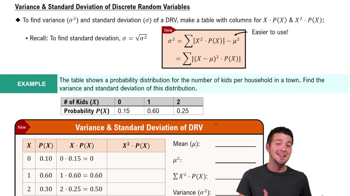
Variance & Standard Deviation of Discrete Random Variables

Continuous Data

Continuous data, in contrast, can take any value within a given range and can be measured rather than counted. Examples include height, weight, or temperature, where values can be infinitely divided. Understanding the difference between discrete and continuous data is crucial for selecting appropriate statistical methods for analysis.
Recommended video:
Guided course
04:39
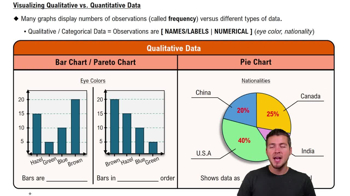
Visualizing Qualitative vs. Quantitative Data

Data Sets

A data set is a collection of related data points that can be analyzed to extract meaningful information. Data sets can be classified as either discrete or continuous based on the nature of the data they contain. Recognizing the type of data set is essential for applying the correct statistical techniques and interpreting results accurately.
Recommended video:
Guided course
04:39
Visualizing Qualitative vs. Quantitative Data
Related Practice
Textbook Question

In Exercises 9–12, determine whether the sampling method appears to be sound or is flawed.


Clinical Trials Researchers at Yale University conduct a wide variety of clinical trials by using subjects who volunteer after reading advertisements soliciting paid volunteers.

293
views
Textbook Question

Parameter and Statistic In a Citrix Security survey of 1001 adults in the United States, it was found that 69% of those surveyed believe that having their personal information stolen is inevitable. Identify the population and sample. Is the value of 69% a statistic or a parameter?

320
views
Textbook Question

In Exercises 13–20, determine whether the data are from a discrete or continuous data set.

Statistics Classes In each of her classes, a statistics professor records the number of students who earned a grade of A.

366
views
Textbook Question

In Exercises 9–20, identify which of these types of sampling is used: random, systematic, convenience, stratified, or cluster.

Criminology Researchers randomly selected 50 convicted felons from each category of burglary, auto theft, and assault.

325
views
Textbook Question

In Exercises 13–20, determine whether the results appear to have statistical significance, and also determine whether the results appear to have practical significance.


Election Fraud The County Clerk in Essex County, New Jersey, was responsible for randomly assigning the order in which candidates’ names appeared on a recent election ballot. Among 41 different ballots, a Democrat was placed on the first line 40 times, and a Republican was placed on the first line once.

259
views
Textbook Question

Computer Virus In an AOL survey of Internet users, this question was posted online: “Have you ever been hit by a computer virus?” Among the 170,063 responses, 63% answered “yes.” What term is used to describe this type of survey in which the people surveyed consist of those who chose to respond? What is wrong with this type of sampling method?

516
views