Join thousands of students who trust us to help them ace their exams!
Multiple Choice
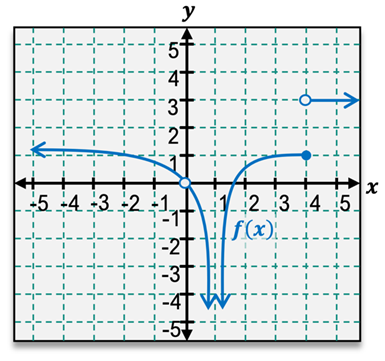
Using the graph, find the specified limit or state that the limit does not exist (DNE). limx→0−f(x) , limx→0+f(x), limx→0f(x)
A
limx→0−f(x)=0, limx→0+f(x)=0, limx→0f(x)=0
B
limx→0−f(x)=0, limx→0+f(x)=0, limx→0f(x)=DNE
C
limx→0−f(x)=−1, limx→0+f(x)=−1, limx→0f(x)=DNE
D
limx→0−f(x)=−1, limx→0+f(x)=−1, limx→0f(x)=−1
0 Comments
Verified step by step guidance
1
Observe the graph of the function f(x) and identify the behavior of the function as x approaches 0 from the left (x -> 0^-). Notice that the graph approaches the y-value of -1 as x approaches 0 from the left.
Next, examine the behavior of the function as x approaches 0 from the right (x -> 0^+). The graph also approaches the y-value of -1 as x approaches 0 from the right.
Since both the left-hand limit and the right-hand limit as x approaches 0 are equal to -1, we can conclude that the two-sided limit exists and is equal to -1.
Therefore, the limit of f(x) as x approaches 0 is -1, which means lim_{x\(\rightarrow\)0}f(x) = -1.
In summary, the limits are: lim_{x\(\rightarrow\)0^{-}}f(x) = -1, lim_{x\(\rightarrow\)0^{+}}f(x) = -1, and lim_{x\(\rightarrow\)0}f(x) = -1.


 Verified step by step guidance

