Skip to main content
Physics
My Course
Learn
Exam Prep
AI Tutor
Study Guides
Textbook Solutions
Flashcards
Explore
Try the app
My Course
Learn
Exam Prep
AI Tutor
Study Guides
Textbook Solutions
Flashcards
Explore
Try the app
Back
Trig Review definitions
You can tap to flip the card.
Vector
You can tap to flip the card.
👆
Vector
A quantity with both magnitude and direction, represented by an arrow in the XY plane.
Track progress
Control buttons has been changed to "navigation" mode.
1/15
Related flashcards
Related practice
Recommended videos
Trig Review quiz
Trig Review
15 Terms
Unit Vectors
3. Vectors
4 problems
Topic
Patrick
3. Vectors - Part 1 of 2
4 topics
9 problems
Chapter
Patrick
3. Vectors - Part 2 of 2
4 topics
9 problems
Chapter
Patrick
Guided course
06:03
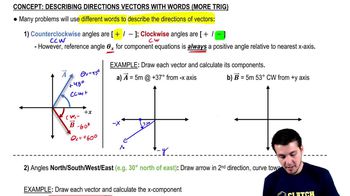
Describing Vectors with Words (More Trig)
7502
views
120
rank
2
comments
Guided course
09:44
Doing Math with Vectors in any Quadrant (More Trig)
11132
views
154
rank
3
comments
Terms in this set (15)
Hide definitions
Vector
A quantity with both magnitude and direction, represented by an arrow in the XY plane.
Magnitude
The length or size of a vector, always a positive value.
Component
The projection of a vector along the axes, can be positive or negative based on direction.
Quadrant
One of the four sections of the XY plane, each with distinct sign conventions for vector components.
Reference Angle
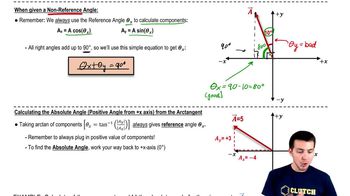
The angle between a vector and the nearest x-axis, used in trigonometric calculations.
Absolute Angle
The angle of a vector measured from the positive x-axis, requiring adjustments for quadrant.
Clockwise
A direction of rotation that results in negative angle measurements.
Counterclockwise
A direction of rotation that results in positive angle measurements.
Cardinal Directions
The four main directions: north, east, south, and west, used to describe vector orientation.
Cosine
A trigonometric function used to calculate the x-component of a vector.
Sine
A trigonometric function used to calculate the y-component of a vector.
Inverse Tangent
A function used to find the reference angle from the ratio of vector components.
Arc Tangent
Another term for inverse tangent, used to determine angles from component ratios.
Compass Directions
Directions like northeast or southwest, indicating vector orientation relative to cardinal points.
Sign Convention
Rules determining the positive or negative sign of vector components based on direction.
 BackBack
 06:03
06:03