Skip to main content
Physics
My Course
Learn
Exam Prep
AI Tutor
Study Guides
Textbook Solutions
Flashcards
Explore
My Course
Learn
Exam Prep
AI Tutor
Study Guides
Textbook Solutions
Flashcards
Explore
Back
Standing Sound Waves definitions
You can tap to flip the card.
Define:
Longitudinal Waves
You can tap to
flip the card.
👆
Longitudinal Waves
Waves where particle displacement is parallel to wave direction, typical in sound waves.
Track progress
Control buttons has been changed to "navigation" mode.
1/15
Related practice
Recommended videos
Guided course
05:17
Standing Sound Waves
Patrick
4571
views
64
rank
4
comments
Guided course
03:24
Example 1
Patrick
2929
views
55
rank
2
comments
Terms in this set (15)
Hide definitions
Longitudinal Waves
Waves where particle displacement is parallel to wave direction, typical in sound waves.
Transverse Waves
Waves where particle displacement is perpendicular to wave direction, typical in strings.
Standing Waves
Waves that remain in a constant position, formed by interference of two waves traveling in opposite directions.
Open Pipe
A pipe with both ends open, where standing waves have antinodes at each end.
Closed Pipe
A pipe with one end closed, where standing waves have a node at the closed end and an antinode at the open end.
Antinode
A point in a standing wave with maximum amplitude, occurring at open ends of pipes.
Node
A point in a standing wave with zero amplitude, occurring at closed ends of pipes.
Fundamental Frequency
The lowest frequency at which a system oscillates, corresponding to n=1.
Harmonics
Frequencies that are integer multiples of the fundamental frequency.
Overtone
Any frequency higher than the fundamental frequency, often referred to by its order.
Speed of Sound
The speed at which sound waves travel through a medium, typically 343 m/s in air.
Frequency Equation
For open pipes: nv/2L; for closed pipes: nv/4L, where n is harmonic number.
Wavelength Equation
For open pipes: 2L/n; for closed pipes: 4L/n, where n is harmonic number.
Odd Integers
Numbers like 1, 3, 5, etc., used for harmonic numbers in closed pipes.
Third Overtone
The fourth harmonic in open pipes, seventh harmonic in closed pipes.
 BackBack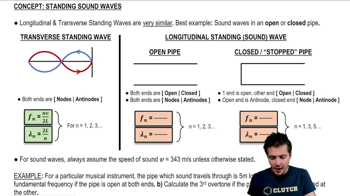
 05:17
05:17