Skip to main content
Physics
My Course
Learn
Exam Prep
AI Tutor
Study Guides
Textbook Solutions
Flashcards
Explore
Try the app
My Course
Learn
Exam Prep
AI Tutor
Study Guides
Textbook Solutions
Flashcards
Explore
Try the app
Back
Simple Harmonic Motion of Pendulums definitions
You can tap to flip the card.
Simple Harmonic Motion
You can tap to flip the card.
👆
Simple Harmonic Motion
A type of periodic motion where the restoring force is directly proportional to the displacement.
Track progress
Control buttons has been changed to "navigation" mode.
1/15
Related flashcards
Related practice
Recommended videos
Simple Harmonic Motion of Pendulums quiz #1
Simple Harmonic Motion of Pendulums
10 Terms
Simple Harmonic Motion of Pendulums
17. Periodic Motion
7 problems
Topic
Patrick
Energy in Pendulums
17. Periodic Motion
4 problems
Topic
Patrick
17. Periodic Motion - Part 1 of 2
4 topics
10 problems
Chapter
Patrick
17. Periodic Motion - Part 2 of 2
3 topics
9 problems
Chapter
David-Paige
Guided course
05:39
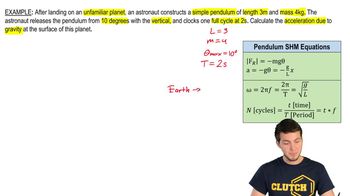
Example
5137
views
87
rank
2
comments
Guided course
08:31
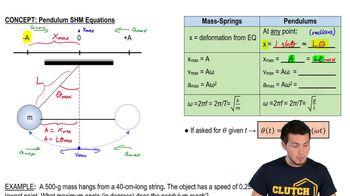
Pendulum Equations
6900
views
89
rank
2
comments
Guided course
03:13
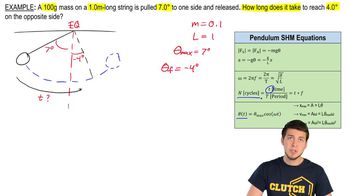
Example
5756
views
76
rank
4
comments
Terms in this set (15)
Hide definitions
Simple Harmonic Motion
A type of periodic motion where the restoring force is directly proportional to the displacement.
Pendulum
A weight suspended from a pivot so it can swing freely, exhibiting simple harmonic motion.
Mass Spring System
A system where a mass is attached to a spring, displaying simple harmonic motion.
Restoring Force
The force that brings a system back to its equilibrium position, proportional to displacement.
Amplitude
The maximum extent of a vibration or oscillation, measured from the position of equilibrium.
Angular Frequency
The rate of change of the phase of a sinusoidal waveform, calculated as the square root of g over l for pendulums.
Theta
The angle of displacement in a pendulum, often approximated as the sine of theta for small angles.
Radians
A unit of angular measure used in many areas of mathematics, where the angle is measured in terms of the radius.
Period
The time taken for one complete cycle of vibration to pass a given point.
Frequency
The number of occurrences of a repeating event per unit of time.
Gravity
The force that attracts a body toward the center of the earth, or toward any other physical body having mass.
Tension Force
The force transmitted through a string, rope, cable or wire when it is pulled tight by forces acting from opposite ends.
Equilibrium Position
The position where the net force on the system is zero, and the system is at rest if undisturbed.
Maximum Velocity
The highest speed reached by an object in simple harmonic motion, occurring at the equilibrium position.
Maximum Acceleration
The greatest acceleration experienced by an object in simple harmonic motion, occurring at the maximum displacement.
 BackBack

 05:39
05:39