Skip to main content
Physics
My Course
Learn
Exam Prep
AI Tutor
Study Guides
Textbook Solutions
Flashcards
Explore
My Course
Learn
Exam Prep
AI Tutor
Study Guides
Textbook Solutions
Flashcards
Explore
Back
Intro to Angular Momentum definitions
You can tap to flip the card.
Define:
Angular Momentum
You can tap to
flip the card.
👆
Angular Momentum
The rotational equivalent of linear momentum, calculated as the product of moment of inertia and angular velocity.
Track progress
Control buttons has been changed to "navigation" mode.
1/15
Related flashcards
Related practice
Recommended videos
Guided course
06:18
Intro to Angular Momentum
Patrick
6215
views
70
rank
7
comments
Terms in this set (15)
Hide definitions
Angular Momentum
The rotational equivalent of linear momentum, calculated as the product of moment of inertia and angular velocity.
Linear Momentum
The product of an object's mass and velocity, representing the quantity of motion in a straight line.
Moment of Inertia
The angular equivalent of mass, representing an object's resistance to changes in rotational motion.
Angular Velocity
The rate of change of angular position of a rotating object, measured in radians per second.
RPM
Revolutions Per Minute, a unit of rotational speed indicating the number of full rotations completed in one minute.
Axis of Rotation
The line around which an object rotates, crucial in determining angular momentum.
Torque
A measure of the force that can cause an object to rotate about an axis, similar to angular momentum.
Radians
A unit of angular measure used in angular velocity, where one radian equals the angle made by an arc of a circle.
Mass
A measure of the amount of matter in an object, contributing to both linear and angular momentum.
Velocity
The speed of an object in a particular direction, used in calculating linear momentum.
Kilograms
The SI unit of mass, used in calculating both linear and angular momentum.
Meters per Second
The SI unit of velocity, used in calculating linear momentum.
Kilograms Meter Squared
The unit of moment of inertia, representing mass distribution in rotational motion.
Radians per Second
The unit of angular velocity, indicating how fast an object rotates.
Frequency
The number of occurrences of a repeating event per unit time, used in converting RPM to angular velocity.
 BackBack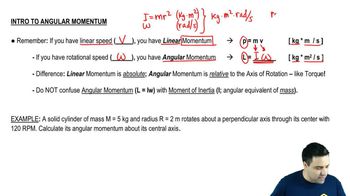
 06:18
06:18
