Skip to main content
Physics
My Course
Learn
Exam Prep
AI Tutor
Study Guides
Textbook Solutions
Flashcards
Explore
My Course
Learn
Exam Prep
AI Tutor
Study Guides
Textbook Solutions
Flashcards
Explore
Back
Gravitational Forces in 2D definitions
You can tap to flip the card.
Define:
Vector Addition
You can tap to
flip the card.
👆
Vector Addition
A method to calculate net forces by combining vectors, considering both magnitude and direction.
Track progress
Control buttons has been changed to "navigation" mode.
1/15
Related flashcards
Related practice
Recommended videos
Guided course
05:41
Gravitational Forces in 2D
Patrick
6410
views
79
rank
2
comments
Guided course
05:18
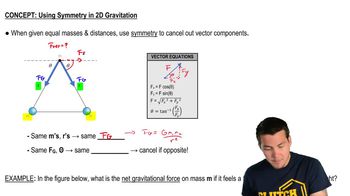
Using Symmetry in 2D Gravitation
Patrick
5100
views
77
rank
2
comments
Guided course
06:28
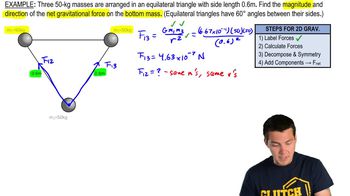
Finding Net Forces in 2D Gravitation
Patrick
4895
views
58
rank
5
comments
Terms in this set (15)
Hide definitions
Vector Addition
A method to calculate net forces by combining vectors, considering both magnitude and direction.
Vector Decomposition
Breaking a vector into its x and y components using trigonometric functions.
Symmetry
A property used to simplify calculations by recognizing equal and opposite forces that cancel out.
Net Gravitational Force
The combined gravitational effect of multiple masses on a single mass, calculated using vector addition.
Equilateral Triangle
A triangle with all sides and angles equal, often used in problems to simplify force calculations.
Newton's Law of Gravitation
A formula to calculate gravitational force between two point masses based on their masses and distance.
Pythagorean Theorem
A mathematical principle used to calculate the magnitude of a vector from its components.
Inverse Tangent
A trigonometric function used to determine the angle of a vector from its components.
Gravitational Force
The attractive force between two masses, proportional to their masses and inversely proportional to the square of the distance between them.
Components
The projections of a vector along the x and y axes, used in vector decomposition.
Angle Theta
The angle used in vector decomposition, typically measured from the x-axis.
Opposite Interior Angles
Angles formed between parallel lines and a transversal, used to determine angles in vector problems.
Coordinate System
A reference framework consisting of x and y axes used to define vector components.
Sine and Cosine
Trigonometric functions used to calculate the components of a vector.
Magnitude
The size or length of a vector, calculated using the Pythagorean theorem for its components.
 BackBack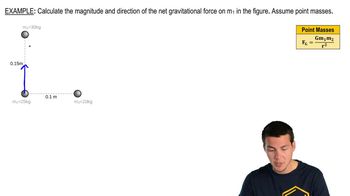
 05:41
05:41