Skip to main content
Physics
My Course
Learn
Exam Prep
AI Tutor
Study Guides
Textbook Solutions
Flashcards
Explore
My Course
Learn
Exam Prep
AI Tutor
Study Guides
Textbook Solutions
Flashcards
Explore
Back
Entropy and the Second Law of Thermodynamics definitions
You can tap to flip the card.
Define:
Entropy
You can tap to flip the card.
👆
Entropy
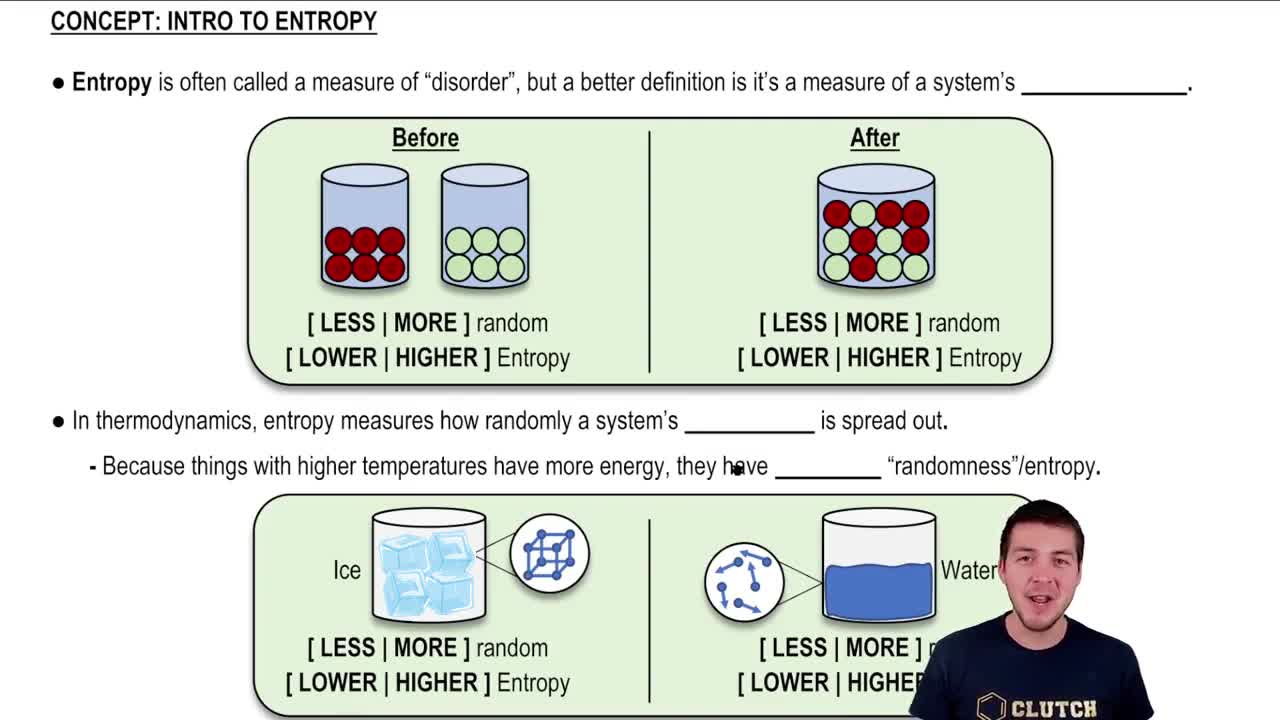
A measure of randomness or disorder in a system, related to the spread of energy at the atomic level.
Track progress
Control buttons has been changed to "navigation" mode.
1/15
Related flashcards
Related practice
Recommended videos
Entropy and the Second Law of Thermodynamics quiz
Entropy and the Second Law of Thermodynamics
10 Terms
Entropy and the Second Law of Thermodynamics quiz #1
Entropy and the Second Law of Thermodynamics
10 Terms
Entropy and the Second Law of Thermodynamics
23. The Second Law of Thermodynamics
7 problems
Topic
Patrick
23. The Second Law of Thermodynamics - Part 1 of 2
4 topics
9 problems
Chapter
Patrick
23. The Second Law of Thermodynamics - Part 2 of 2
4 topics
8 problems
Chapter
Patrick
Guided course
07:50
Intro to Entropy
Patrick
3856
views
32
rank
1
comments
Guided course
03:40
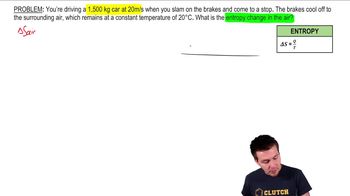
Entropy Increase When Braking
Patrick
2861
views
21
rank
Guided course
06:20
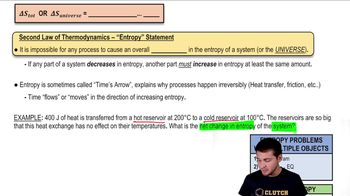
Calculating Entropy Changes for Systems of Objects
Patrick
2775
views
22
rank
Terms in this set (15)
Hide definitions
Entropy
A measure of randomness or disorder in a system, related to the spread of energy at the atomic level.
Isothermal Process
A thermodynamic process where the temperature remains constant throughout.
Second Law of Thermodynamics
States that the total entropy of a system or the universe can never decrease; it can only increase or remain constant.
Heat Transfer
The movement of thermal energy from a hotter object to a cooler one, increasing the entropy of the system.
Kelvin
The SI unit of temperature, used in thermodynamic equations to ensure consistency.
Latent Heat of Fusion
The heat required to change a substance from solid to liquid without changing its temperature.
Phase Change
A transition of matter from one state to another, such as from liquid to solid, involving energy transfer.
Randomness
The degree of disorder or unpredictability in a system, contributing to its entropy.
Joules per Kelvin
The unit of measurement for entropy, representing energy per unit temperature.
Hot Reservoir
A source of thermal energy at a higher temperature, often used in thermodynamic cycles.
Cold Reservoir
A sink for thermal energy at a lower temperature, receiving heat in thermodynamic processes.
Delta S
Symbol representing the change in entropy, calculated as heat transfer divided by temperature.
Time's Arrow
A concept describing the one-way direction of time, associated with the increase of entropy.
Friction
A force that opposes motion, generating heat and increasing the entropy of a system.
Energy Spread
The distribution of energy within a system, influencing its level of entropy.
 BackBack
 07:50
07:50