Skip to main content
Physics
My Course
Learn
Exam Prep
AI Tutor
Study Guides
Textbook Solutions
Flashcards
Explore
My Course
Learn
Exam Prep
AI Tutor
Study Guides
Textbook Solutions
Flashcards
Explore
Back
Dipole Moment definitions
You can tap to flip the card.
Define:
Electric Dipole
You can tap to
flip the card.
👆
Electric Dipole
Two equal and opposite charges separated by a distance, forming a system with a dipole moment.
Track progress
Control buttons has been changed to "navigation" mode.
1/15
Related flashcards
Related practice
Recommended videos
Guided course
03:08
Intro To Dipole Moment
Patrick
9699
views
128
rank
9
comments
Guided course
05:19
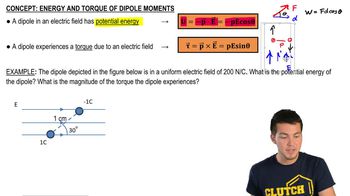
Energy & Torque of Dipole Moments
Patrick
7383
views
142
rank
7
comments
Terms in this set (15)
Hide definitions
Electric Dipole
Two equal and opposite charges separated by a distance, forming a system with a dipole moment.
Dipole Moment
A vector quantity calculated as the product of charge magnitude and distance vector, pointing from positive to negative charge.
Vector Form
Representation of a vector using components in the i and j directions, indicating direction and magnitude.
Potential Energy
Energy acquired by a dipole in an electric field, calculated as -P * E * cos(theta).
Torque
Rotational effect experienced by a dipole in an electric field, calculated as P * E * sin(theta).
Uniform Electric Field
An electric field with constant magnitude and direction throughout a given space.
Dot Product
A mathematical operation that multiplies two vectors, yielding a scalar, used in calculating potential energy.
Angle Theta
The angle between the dipole moment vector and the electric field vector, crucial in energy and torque calculations.
Component Form
Expression of a vector in terms of its horizontal (i) and vertical (j) components.
Newton Meter
The unit of torque, representing the rotational force applied over a distance.
Coulomb Meter
The unit of dipole moment, representing the product of charge and distance.
Magnitude
The size or length of a vector, disregarding its direction.
Distance Vector
A vector pointing from the positive charge to the negative charge in a dipole.
Cosine Function
A trigonometric function used to calculate the component of a vector in the direction of another vector.
Sine Function
A trigonometric function used to calculate the perpendicular component of a vector relative to another vector.
 BackBack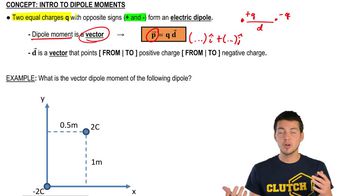
 03:08
03:08