Skip to main content
Physics
My Course
Learn
Exam Prep
AI Tutor
Study Guides
Textbook Solutions
Flashcards
Explore
My Course
Learn
Exam Prep
AI Tutor
Study Guides
Textbook Solutions
Flashcards
Explore
Back
Intro to Connected Wheels definitions
You can tap to flip the card.
Define:
Tangential Velocity
You can tap to
flip the card.
👆
Tangential Velocity
The linear speed at the edge of a rotating object, equal for connected wheels via a chain or belt.
Track progress
Control buttons has been changed to "navigation" mode.
1/15
Related practice
Recommended videos
Guided course
08:57
Intro to Connected Wheels
Patrick
4687
views
50
rank
3
comments
Guided course
03:41
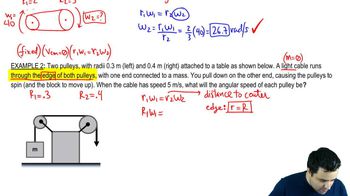
Speed of pulleys of different radii
Patrick
3681
views
52
rank
4
comments
Terms in this set (15)
Hide definitions
Tangential Velocity
The linear speed at the edge of a rotating object, equal for connected wheels via a chain or belt.
Angular Velocity
The rate of rotation of an object, differing for wheels of different radii when connected.
Fixed Axis
A point around which a wheel rotates without moving sideways, like a bolted gear.
Free Axis
Allows a wheel to move as it rotates, typical in bicycles where wheels are not fixed.
Radius
The distance from the center to the edge of a wheel, affecting its angular speed.
Rotational Kinematics
The study of motion of rotating objects, often involving connected wheels.
Chain
A connector that ensures equal tangential velocity between two rotating wheels.
Belt
A flexible loop that transmits motion and force between rotating wheels.
Frequency
The number of rotations per unit time, interchangeable with angular velocity in equations.
Period
The time taken for one complete rotation, inversely related to frequency.
RPM
Revolutions per minute, a measure of rotational speed, convertible to angular velocity.
Gears
Toothed wheels that interlock to transmit motion, often used in connected wheel problems.
Pulleys
Wheels on an axle designed to support movement and change direction of a belt or chain.
Inverse Relationship
A situation where an increase in one quantity results in a decrease in another, such as radius and angular speed.
Equation Variations
Different forms of the main equation using frequency, period, and RPM to solve rotational problems.
 BackBack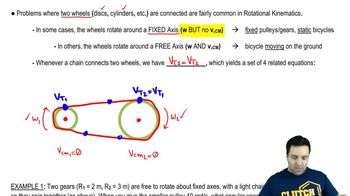
 08:57
08:57