Skip to main content
Physics
My Course
Learn
Exam Prep
AI Tutor
Study Guides
Textbook Solutions
Flashcards
Explore
My Course
Learn
Exam Prep
AI Tutor
Study Guides
Textbook Solutions
Flashcards
Explore
Back
Charging Objects definitions
1 student found this helpful
You can tap to flip the card.
Electricity
You can tap to
flip the card.
👆
Electricity
The movement of electrons or electric charges, primarily within conductors.
Track progress
Control buttons has been changed to "navigation" mode.
1/15
Related flashcards
Related practice
Recommended videos
Guided course
06:36
Charging Objects
Patrick
15125
views
521
rank
6
comments
Terms in this set (15)
Hide definitions
Electricity
The movement of electrons or electric charges, primarily within conductors.
Conductors
Materials that allow electrons and electric charges to move freely, like metals.
Insulators
Materials that restrict electron movement, such as plastics and rubber.
Electrons
Subatomic particles that move within conductors, enabling electricity.
Protons
Subatomic particles with a positive charge that do not move in conductors.
Polarization
Separation of charges in an object, resulting in no net charge.
Conduction
Transfer of charges through direct contact, occurring only in conductors.
Net Charge
The overall charge of an object after conduction, can be positive or negative.
Positive Charge
Charge type that attracts electrons and repels other positive charges.
Negative Charge
Charge type that attracts protons and repels other negative charges.
Charge Transfer
Movement of electric charge from one object to another, often by rubbing.
Electric Charge
Property of matter that causes it to experience a force in an electric field.
Neutral Conductor
A conductor with equal numbers of positive and negative charges.
Glass Rod
An object used in experiments to demonstrate charge transfer and polarization.
Opposites Attract
Principle stating that unlike charges attract each other.
 Back
Back
 Back
Back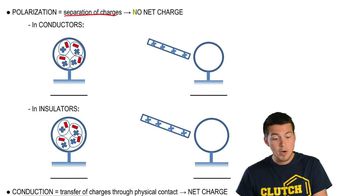
 06:36
06:36
