Skip to main content
Physics
My Course
Learn
Exam Prep
AI Tutor
Study Guides
Textbook Solutions
Flashcards
Explore
My Course
Learn
Exam Prep
AI Tutor
Study Guides
Textbook Solutions
Flashcards
Explore
Back
Buoyancy & Buoyant Force definitions
You can tap to flip the card.
Define:
Buoyancy
You can tap to
flip the card.
👆
Buoyancy
The phenomenon causing objects to float or rise in a liquid due to pressure differences.
Track progress
Control buttons has been changed to "navigation" mode.
1/15
Related flashcards
Related practice
Recommended videos
Guided course
11:06
Intro to Buoyancy & Buoyant Force
Patrick
6612
views
86
rank
6
comments
Guided course
03:14
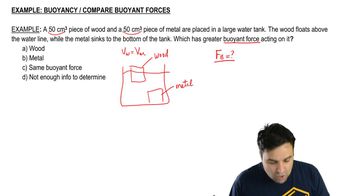
Comparing Buoyant Forces
Patrick
4546
views
54
rank
2
comments
Guided course
16:56
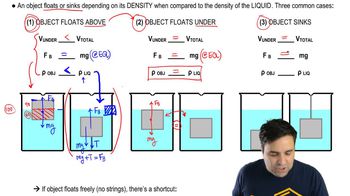
Buoyancy / Three Common Cases
Patrick
4862
views
54
rank
4
comments
Terms in this set (15)
Hide definitions
Buoyancy
The phenomenon causing objects to float or rise in a liquid due to pressure differences.
Buoyant Force
The upward force exerted by a fluid on a submerged object, equal to the weight of the fluid displaced.
Archimedes' Principle
States that the buoyant force on a submerged object is equal to the weight of the liquid displaced.
Density
The mass of an object divided by its total volume, crucial for solving buoyancy problems.
Equilibrium
A state where the net force is zero, often occurring when buoyant force equals gravitational force.
Apparent Weight
The weight of an object in a fluid, affected by buoyant force, measured by tension or normal force.
Pressure Difference
The variation in pressure between the top and bottom of a submerged object, causing buoyant force.
Volume Submerged
The portion of an object's volume that is underwater, crucial for calculating buoyant force.
Normal Force
The force exerted by a surface to support the weight of an object resting on it, often counteracting gravity.
Tension
The force transmitted through a string or cable when it is pulled tight by forces acting from opposite ends.
Gravitational Acceleration
The acceleration due to gravity, typically 9.8 m/s² on Earth, used in buoyancy calculations.
Liquid Density
The mass per unit volume of a liquid, a key factor in determining buoyant force.
Floating
The condition where an object remains on the surface of a liquid due to its lower density.
Sinking
The condition where an object descends in a liquid due to its higher density compared to the liquid.
Suspended
The state where an object remains submerged but does not sink or rise, having equal density to the liquid.
 BackBack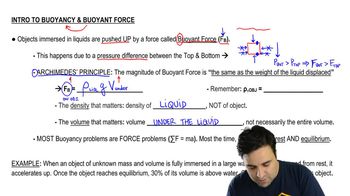
 11:06
11:06