Skip to main content
Physics
My Course
Learn
Exam Prep
AI Tutor
Study Guides
Textbook Solutions
Flashcards
Explore
My Course
Learn
Exam Prep
AI Tutor
Study Guides
Textbook Solutions
Flashcards
Explore
Back
Beam / Shelf Against a Wall definitions
2 students found this helpful
You can tap to flip the card.
Define:
Static Equilibrium
You can tap to
flip the card.
👆
Static Equilibrium
A state where an object is at rest with all forces and torques balanced, resulting in no motion.
Track progress
Control buttons has been changed to "navigation" mode.
1/15
Related practice
Recommended videos
Guided course
17:08
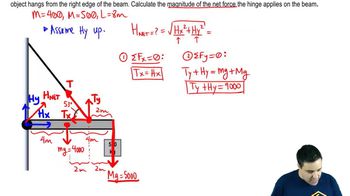
Beam / Shelf Against a Wall
Patrick
3853
views
21
rank
7
comments
Guided course
13:40
Beam supporting an object
Patrick
2115
views
9
rank
10
comments
Terms in this set (15)
Hide definitions
Static Equilibrium
A state where an object is at rest with all forces and torques balanced, resulting in no motion.
Beam
A long, rigid object that is subject to forces and torques, often used in static equilibrium problems.
Tension
A force transmitted through a cable or rod, often decomposed into horizontal and vertical components.
Hinge Force
A force applied by a hinge, typically with horizontal and vertical components, to maintain equilibrium.
Torque
A measure of the rotational force applied at a distance from an axis, influencing an object's rotation.
Mass of the Beam (MG)
The gravitational force acting on the beam, calculated as mass times gravitational acceleration.
Decomposition of Forces
The process of breaking a force into its horizontal and vertical components.
Equilibrium Equations
Mathematical expressions ensuring the sum of forces and torques equals zero for equilibrium.
Net Force
The vector sum of all forces acting on an object, which must be zero in static equilibrium.
Symmetry in Problem Setup
A condition where forces and angles are balanced, often simplifying calculations in equilibrium problems.
Angle of Tension
The angle at which a tension force is applied, affecting its horizontal and vertical components.
Horizontal Axis
The axis along which horizontal forces are analyzed in equilibrium problems.
Vertical Axis
The axis along which vertical forces are analyzed in equilibrium problems.
Pythagorean Theorem
A mathematical principle used to calculate the resultant force from its components.
Gravitational Acceleration
The acceleration due to gravity, typically approximated as 10 m/s² in calculations.
 BackBack
 17:08
17:08