
Ch. 21 - Electric Charge and Electric Field
Giancoli Douglas - Physics for Scientists and Engineers 5th edition
Giancoli Douglas5th editionPhysics for Scientists and EngineersISBN: 9780137488179Not the one you use?Change textbook
Chapter 21, Problem 89

Draw, approximately, the electric field lines about two point charges, +Q and -3Q, which are a distance ℓ apart.

Verified step by step guidance
1
Start by recalling the basic properties of electric field lines: (1) They originate from positive charges and terminate on negative charges, (2) The density of lines represents the strength of the electric field, and (3) Electric field lines never cross.
Identify the charges in the problem: +Q (positive) and -3Q (negative). Since the magnitude of -3Q is three times that of +Q, the electric field lines terminating on -3Q will be denser compared to those originating from +Q.
Draw the electric field lines. Begin by placing the charges on the diagram, separated by a distance ℓ. From the +Q charge, draw lines radiating outward. Ensure that for every one line leaving +Q, three lines terminate on -3Q to reflect the relative magnitudes of the charges.
Ensure symmetry in the diagram. The electric field lines should curve and connect the charges, showing the interaction between them. Near the charges, the lines should be denser, indicating stronger fields. Farther away, the lines should spread out.
Finally, check the diagram for accuracy: (1) The lines should originate from +Q and terminate on -3Q, (2) The number of lines should reflect the charge ratio (1:3), and (3) The lines should not cross or form closed loops.

Verified video answer for a similar problem:

This video solution was recommended by our tutors as helpful for the problem above.
Video duration:
6m
Was this helpful?

Key Concepts

Here are the essential concepts you must grasp in order to answer the question correctly.

Electric Field

An electric field is a region around a charged particle where other charged particles experience a force. It is represented by field lines that indicate the direction and strength of the force. The field lines point away from positive charges and toward negative charges, illustrating how a positive test charge would move in the presence of the electric field.
Recommended video:
Guided course
03:16
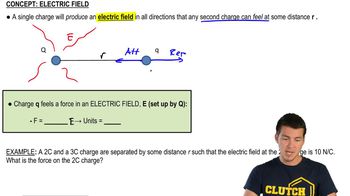
Intro to Electric Fields

Superposition Principle

The superposition principle states that the total electric field created by multiple charges is the vector sum of the electric fields produced by each charge individually. This means that when analyzing the electric field around multiple charges, one can calculate the field due to each charge separately and then combine them to find the resultant field.
Recommended video:
Guided course
03:32
Superposition of Sinusoidal Wave Functions

Field Line Density

Field line density refers to the number of electric field lines per unit area in a given region. A higher density of lines indicates a stronger electric field, while a lower density indicates a weaker field. The direction of the lines shows the direction of the force on a positive charge, and the spacing between lines helps visualize the strength of the field.
Recommended video:
Guided course
08:20
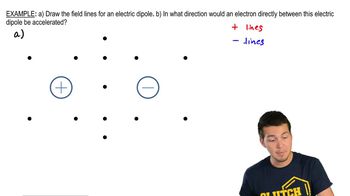
Electric Field Lines