Ch. 07 - Work and Energy
Giancoli Douglas - Physics for Scientists and Engineers 5th edition
Giancoli Douglas5th editionPhysics for Scientists and EngineersISBN: 9780137488179Not the one you use?Change textbook
Chapter 7, Problem 77

The force required to compress an “imperfect” horizontal spring (doesn’t follow Hooke’s law) an amount x is given by F = 150x + 12x³, where x is in meters and F in newtons. If the spring is compressed 2.0 m, what speed will it give to a 3.0-kg ball held against it and then released?

Verified step by step guidance
1
Understand the problem: The spring does not follow Hooke's law, and the force is given by the equation F = 150x + 12x³. To find the speed of the ball, we need to calculate the work done by the spring (stored as potential energy) and then use the work-energy principle to find the kinetic energy and speed of the ball.
Step 1: Write the expression for the work done by the spring. Work is the integral of force over displacement. The work done by the spring is given by: W = ∫(150x + 12x³) dx, where the limits of integration are from x = 0 to x = 2.0 m.
Step 2: Perform the integration. The integral of 150x is (150x²)/2, and the integral of 12x³ is (12x⁴)/4. Combine these results to get the total work done: W = [(150x²)/2 + (12x⁴)/4] evaluated from x = 0 to x = 2.0 m.
Step 3: Use the work-energy principle. The work done by the spring is converted into the kinetic energy of the ball. The kinetic energy is given by KE = (1/2)mv², where m is the mass of the ball and v is its speed. Set W = KE to find the speed: [(150x²)/2 + (12x⁴)/4] = (1/2)(3.0)v².
Step 4: Solve for v. Substitute x = 2.0 m into the expression for work, simplify the equation, and solve for v. This will give the speed of the ball after it is released from the spring.

Verified video answer for a similar problem:

This video solution was recommended by our tutors as helpful for the problem above.
Video duration:
7m
Was this helpful?

Key Concepts

Here are the essential concepts you must grasp in order to answer the question correctly.

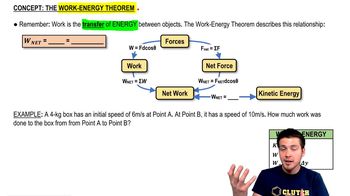
Work-Energy Principle

The Work-Energy Principle states that the work done on an object is equal to the change in its kinetic energy. In this context, the work done by the spring when compressed will be converted into kinetic energy of the ball when it is released. This principle allows us to relate the force exerted by the spring to the speed of the ball.
Recommended video:
Guided course
04:10
The Work-Energy Theorem

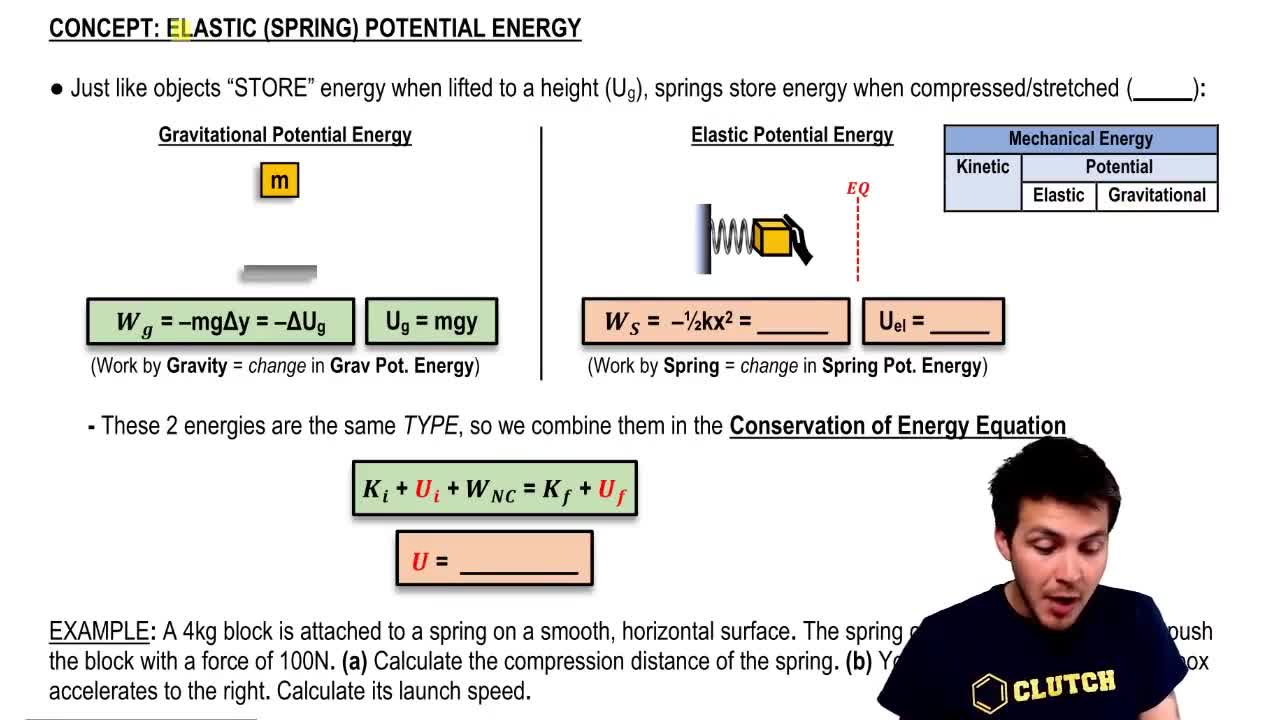
Potential Energy of a Spring

The potential energy stored in a spring is given by the integral of the force applied to compress or stretch it. For a non-linear spring, like the one described, the potential energy can be calculated by integrating the force function F = 150x + 12x³ over the distance compressed. This energy will be converted into kinetic energy when the spring is released.
Recommended video:
Guided course
06:18
Energy in Horizontal Springs

Kinetic Energy

Kinetic energy is the energy an object possesses due to its motion, calculated using the formula KE = 0.5mv², where m is the mass and v is the velocity. After the spring releases the ball, the potential energy stored in the spring transforms into kinetic energy, allowing us to determine the speed of the ball based on its mass and the energy transferred.
Recommended video:
Guided course
06:07
Intro to Rotational Kinetic Energy
Related Practice
Textbook Question

At room temperature, an oxygen molecule, with mass of 5.31 x 10⁻²⁶ kg, typically has a kinetic energy of about 6.21 x 10⁻²¹ J . How fast is it moving?

2119
views

Textbook Question

A 25-g projectile is fired into a cube of ballistic gel at a velocity of 360 m/s. If the projectile penetrates 15 cm into the gel before stopping, find the average force exerted by the gel onto the projectile. Use kinematics and dynamics (Newton's laws).

1350
views
Textbook Question

A 3.5-kg object moving in two dimensions initially has a velocity v1\(\overrightarrow{v_1}\)_{} = (10.0 î + 20.0 ĵ) m/s. A net force F\(\overrightarrow{F}\) then acts on the object for 2.0 s, after which the object’s velocity is v2\(\overrightarrow{v_2}\)_{} = (15.0 î + 30.0 ĵ) m/s. Determine the work done by F\(\overrightarrow{F}\) on the object.

2236
views
Textbook Question

We usually neglect the mass of a spring if it is small compared to the mass attached to it. But in some applications, the mass of the spring must be taken into account. Consider a spring of unstretched length ℓ and mass MS uniformly distributed along the length of the spring. A mass m is attached to the end of the spring. One end of the spring is fixed and the mass m is allowed to vibrate horizontally without friction (Fig. 7–31). Each point on the spring moves with a velocity proportional to the distance from that point to the fixed end. For example, if the mass on the end moves with speed v₀, the midpoint of the spring moves with speed v₀ / 2. Show that the kinetic energy of the mass plus spring when the mass m is moving with velocity v is K = (1/2)Mv² where M = m + (1/3)MS is the “effective mass” of the system. [Hint: Let D be the total length of the stretched spring. Then the velocity of an infinitesimal length dx of spring, of mass dM, located at x is v(x) = v₀(x/D). Note also that dM = dx( MS/D).]

1741
views
Textbook Question

A car traveling at a velocity v can stop in a minimum distance d. What would be the car’s minimum stopping distance if it were traveling at a velocity of 2v?

2120
views
Textbook Question

In the game of paintball, players use guns powered by pressurized gas to propel 33-g gel capsules filled with paint at the opposing team. Game rules dictate that a paintball cannot leave the barrel of a gun with a speed greater than 85 m/s. Model the shot by assuming the pressurized gas applies a constant force F to a 33-g capsule over the length of the 32-cm barrel. Determine F by using the work-energy principle.

1811
views