Ch. 30 - Inductance, Electromagnetic Oscillations, and AC Circuits
Giancoli Douglas - Physics for Scientists and Engineers 5th edition
Giancoli Douglas5th editionPhysics for Scientists and EngineersISBN: 9780137488179Not the one you use?Change textbook
Chapter 29, Problem 10

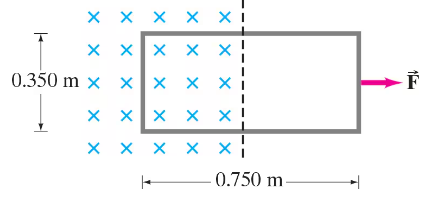
(II) Part of a single rectangular loop of wire with dimensions shown in Fig. 29–49 is situated inside a region of uniform magnetic field of 0.650 T. The total resistance of the loop is 0.250 Ω. Calculate the force required to pull the loop from the field (to the right) at a constant velocity of 3.40 m/s. Neglect gravity.

Verified step by step guidance
1
Step 1: Understand the problem. The wire loop is partially inside a uniform magnetic field, and we need to calculate the force required to pull the loop out of the field at a constant velocity. This involves electromagnetic induction, where a changing magnetic flux induces an electromotive force (EMF) and a current in the loop.
Step 2: Calculate the induced EMF using Faraday's Law of Induction. The EMF (ε) is given by the formula: ε=Blv, where B is the magnetic field strength (0.650 T), l is the length of the wire in the field, and v is the velocity of the loop (3.40 m/s).
Step 3: Determine the current in the loop using Ohm's Law. The current I is given by: I=εR, where R is the resistance of the loop (0.250 Ω). Substitute the value of ε from Step 2 into this formula.
Step 4: Calculate the magnetic force acting on the wire. The force F is given by: F=IlB, where I is the current (from Step 3), l is the length of the wire in the field, and B is the magnetic field strength.
Step 5: Interpret the result. The force calculated in Step 4 is the force required to pull the loop out of the magnetic field at a constant velocity. This force counteracts the magnetic force due to the induced current in the loop.

Verified video answer for a similar problem:

This video solution was recommended by our tutors as helpful for the problem above.
Video duration:
7m
Was this helpful?

Key Concepts

Here are the essential concepts you must grasp in order to answer the question correctly.

Electromagnetic Induction

Electromagnetic induction is the process by which a changing magnetic field within a closed loop induces an electromotive force (EMF) in the wire. This phenomenon is described by Faraday's Law, which states that the induced EMF is proportional to the rate of change of magnetic flux through the loop. In this scenario, as the loop is pulled out of the magnetic field, the change in magnetic flux induces a current in the loop.
Recommended video:
Guided course
05:42
Introduction to Induction

Lorentz Force

The Lorentz force is the force experienced by a charged particle moving through a magnetic field. It is given by the equation F = q(v × B), where F is the force, q is the charge, v is the velocity of the particle, and B is the magnetic field. In the context of the loop, the induced current creates a magnetic field that interacts with the external magnetic field, resulting in a force that opposes the motion of the loop, known as Lenz's Law.
Recommended video:
Guided course
13:39
Lorentz Transformations of Velocity

Ohm's Law

Ohm's Law relates the voltage (V), current (I), and resistance (R) in an electrical circuit, expressed as V = IR. In this problem, the induced EMF in the loop causes a current to flow, which can be calculated using the total resistance of the loop. Understanding Ohm's Law is essential for determining the current generated by the induced EMF, which in turn affects the force required to pull the loop from the magnetic field.
Recommended video:
Guided course
03:07
Resistance and Ohm's Law