Ch. 34 - The Wave Nature of Light: Interference and Polarization
Giancoli Douglas - Physics for Scientists and Engineers 5th edition
Giancoli Douglas5th editionPhysics for Scientists and EngineersISBN: 9780137488179Not the one you use?Change textbook
Chapter 33, Problem 20

In a two-slit interference experiment, the path length to a certain point P on the screen differs for one slit in comparison with the other by 1.25λ.
(a) What is the phase difference between the two waves arriving at point P?
(b) Determine the intensity at P, expressed as a fraction of the maximum intensity Iₒ on the screen.

Verified step by step guidance
1
To determine the phase difference between the two waves arriving at point P, recall that the phase difference Δϕ is related to the path difference Δx by the formula: Δϕ=2πΔx/λ. Here, the path difference Δx is given as 1.25λ. Substitute this value into the formula to calculate Δϕ.
Simplify the expression for Δϕ: Δϕ=2π(1.25). This will give the phase difference in radians.
To determine the intensity at point P, use the formula for intensity in a two-slit interference pattern: I=Io(cos2(Δϕ/2)), where Io is the maximum intensity and Δϕ is the phase difference calculated earlier.
Substitute the value of Δϕ from step 2 into the intensity formula. Simplify the expression to find the intensity at point P as a fraction of the maximum intensity Io.
The final result will express the intensity at point P as a fraction of the maximum intensity. Ensure that the cosine function is evaluated correctly, and the fraction is simplified if possible.

Verified video answer for a similar problem:

This video solution was recommended by our tutors as helpful for the problem above.
Video duration:
5m
Was this helpful?

Key Concepts

Here are the essential concepts you must grasp in order to answer the question correctly.

Interference of Waves

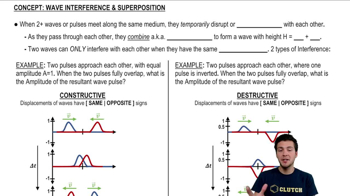
Interference occurs when two or more waves overlap and combine to form a new wave pattern. In the context of the two-slit experiment, constructive interference happens when waves from both slits arrive in phase, while destructive interference occurs when they arrive out of phase. The resulting intensity pattern on the screen is a direct consequence of these interference effects.
Recommended video:
Guided course
03:47
Wave Interference & Superposition

Phase Difference

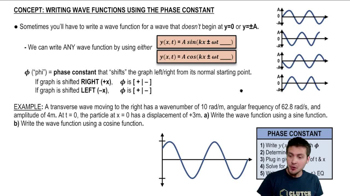
Phase difference refers to the difference in the phase of two waves at a given point in time. It is typically measured in radians or wavelengths (λ). In the two-slit experiment, a path length difference of 1.25λ corresponds to a phase difference of 2.5π radians, which indicates how much one wave is ahead or behind the other when they reach point P.
Recommended video:
Guided course
08:59
Phase Constant of a Wave Function

Intensity of Light

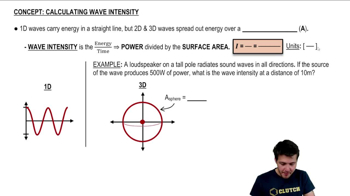
The intensity of light at a point in an interference pattern is related to the amplitude of the resultant wave at that point. The maximum intensity (Iₒ) occurs at points of constructive interference, while the intensity at point P can be calculated using the formula I = Iₒ * (cos²(Δφ/2)), where Δφ is the phase difference. This relationship allows us to express the intensity at P as a fraction of the maximum intensity.
Recommended video:
Guided course
02:32
Wave Intensity
Related Practice
Textbook Question

(II) Suppose a thin piece of glass is placed in front of the lower slit in Fig. 34–7 so that the two waves enter the slits 180° out of phase (Fig. 34–44). Describe in detail the interference pattern on the screen.

79
views

Textbook Question

(II) Light of wavelength λ passes through a pair of slits separated by 0.17 mm, forming a double-slit interference pattern on a screen located a distance 35 cm away. Suppose that the image in Fig. 34–9a is an actual-size reproduction of this interference pattern. Use a ruler to measure a pertinent distance on this image; then utilize this measured value to determine λ (nm) .

1479
views
Textbook Question

(II) Assume that light of a single color, rather than white light, passes through the two-slit setup described in Example 34–4. If the distance from the central fringe to a first-order fringe is measured to be 2.9 mm on the screen, determine the light’s wavelength (in nm) and color (see Fig. 34–11).

1307
views
Textbook Question

(I) If a soap bubble is 120 nm thick, what wavelength is most strongly reflected at the center of the outer surface when illuminated normally by white light? Assume that n = 1.35.

45
views
Textbook Question

Consider three equally spaced and equal-intensity coherent sources of light (such as adding a third slit to the two slits of Fig. 34–12). Determine the positions of minima.

1080
views
Textbook Question

Suppose that one slit of a double-slit apparatus is wider than the other so that the intensity of light passing through it is twice as great. Determine the intensity I as a function of position (θ) on the screen for coherent light.

1335
views