Ch. 04 - Dynamics: Newton's Laws of Motion
Giancoli Douglas - Physics for Scientists and Engineers 5th edition
Giancoli Douglas5th editionPhysics for Scientists and EngineersISBN: 9780137488179Not the one you use?Change textbook
Chapter 4, Problem 7

Superman must stop a 120-km/h train in 150 m to keep it from hitting a stalled car on the tracks. If the train's mass is 3.6 x 10⁵ kg, how much force must he exert? Compare to the weight of the train (give as %). How much force does the train exert on Superman?

Verified step by step guidance
1
Convert the train's initial velocity from km/h to m/s. Use the conversion factor: 1 km/h = 1000 m / 3600 s. The initial velocity \( v_i \) is \( 120 \ \text{km/h} \).
Determine the acceleration \( a \) required to stop the train. Use the kinematic equation: \( v_f^2 = v_i^2 + 2a \Delta x \), where \( v_f \) is the final velocity (0 m/s), \( v_i \) is the initial velocity, and \( \Delta x \) is the stopping distance (150 m). Solve for \( a \).
Calculate the force \( F \) Superman must exert to stop the train. Use Newton's second law: \( F = ma \), where \( m \) is the mass of the train (\( 3.6 \times 10^5 \ \text{kg} \)) and \( a \) is the acceleration found in the previous step.
Compare the force \( F \) to the weight of the train. The weight of the train is given by \( W = mg \), where \( g \) is the acceleration due to gravity (\( 9.8 \ \text{m/s}^2 \)). Calculate the percentage: \( \text{Percentage} = \left( \frac{F}{W} \right) \times 100 \).
Determine the force the train exerts on Superman. By Newton's third law, the force Superman exerts on the train is equal in magnitude and opposite in direction to the force the train exerts on Superman. Thus, the force is the same as \( F \) calculated earlier.

Verified video answer for a similar problem:

This video solution was recommended by our tutors as helpful for the problem above.
Was this helpful?

Key Concepts

Here are the essential concepts you must grasp in order to answer the question correctly.

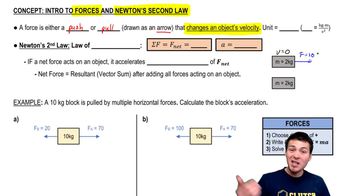
Newton's Second Law of Motion

Newton's Second Law states that the force acting on an object is equal to the mass of that object multiplied by its acceleration (F = ma). This principle is essential for calculating the force Superman must exert to stop the train, as it allows us to determine the required acceleration based on the train's initial speed and stopping distance.
Recommended video:
Guided course
06:54
Intro to Forces & Newton's Second Law

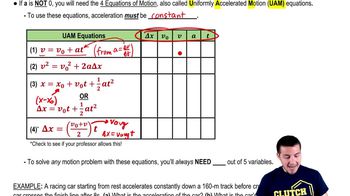
Kinematic Equations

Kinematic equations describe the motion of objects under constant acceleration. In this scenario, we can use these equations to relate the train's initial velocity, final velocity, acceleration, and distance traveled. This will help us find the acceleration needed to stop the train within the specified distance.
Recommended video:
Guided course
08:25
Kinematics Equations

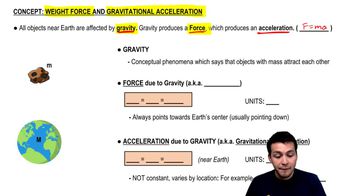
Weight and Gravitational Force

The weight of an object is the force exerted on it due to gravity, calculated as the product of its mass and the acceleration due to gravity (W = mg). Understanding the weight of the train is crucial for comparing the force Superman exerts to stop it, as well as determining the force the train exerts on Superman, which is equal in magnitude but opposite in direction according to Newton's Third Law.
Recommended video:
Guided course
07:32
Weight Force & Gravitational Acceleration