
Suppose you have a car with a 100-hp engine. How large a solar panel would you need to replace the engine with solar power? Assume that the solar panels can utilize 20% of the maximum solar energy that reaches the Earth’s surface (1000 W/m²). Explain why or why not this is practical.
Giancoli Douglas 5th edition
Ch. 31 - Maxwell's Equations and Electromagnetic Waves
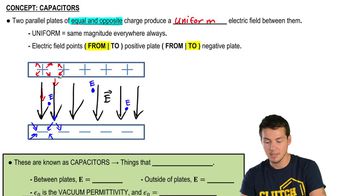
Problem 34a(III) (a) When a circular parallel-plate capacitor is being charged as in Example 31–1, show that the Poynting vector points radially inward toward the center of the capacitor, parallel to the plates.
Verified step by step guidance
Verified video answer for a similar problem:
Key Concepts
Poynting Vector
Electric Field in Capacitors
Magnetic Field and Charging
Suppose that a circular parallel-plate capacitor has radius r₀ = 3.0 cm and plate separation d = 5.0 mm. A sinusoidal potential difference V = V₀ sin (2𝝅ft) is applied across the plates, where V₀ = 180 V and f = 60 Hz. Determine the expression for the amplitude B₀(r) of this time-dependent (sinusoidal) field when r ≤ r₀ and when r > r₀.
In an EM wave traveling west, the B field oscillates up and down vertically and has a frequency of 85.0 kHz and an rms strength of 7.75 x 10⁻⁹ T. Determine the frequency and rms strength of the electric field. What is the direction of the electric field oscillations?
Compare 1030 on the AM dial to 103.1 on FM. Which has the longer wavelength, and by what factor is it larger?
(II) Laser light can be focused (at best) to a spot with a radius r equal to its wavelength ⋋. Suppose a 1.0-W beam of green laser light (⋋ = 5 x 10⁻⁷ m) forms such a spot and illuminates a cylindrical object of radius r and length r (Fig. 31–25). Estimate (a) the radiation pressure and force on the object, and (b) its acceleration, if its density equals that of water and it absorbs all the radiation. [This order-of-magnitude calculation convinced researchers of the feasibility of “optical tweezers,” page 916.]
(a) When a circular parallel-plate capacitor is being charged as in Example 31–1, show that the Poynting vector points radially inward toward the center of the capacitor, parallel to the plates.
(b) Integrate over the cylindrical boundary of the capacitor gap to show that the rate at which energy enters the capacitor is equal to the rate at which electrostatic energy is being stored in the electric field of the capacitor (Section 24–4). Ignore fringing of .