

Agent Arlene devised the following method of measuring the muzzle velocity of a rifle (Fig. 14–34). She fires a bullet into a 4.148-kg wooden block resting on a smooth surface, and attached to a spring of spring constant k = 162.7 N/m. The bullet, whose mass is 7.450 g, remains embedded in the wooden block. She measures the maximum distance that the block compresses the spring to be 9.460 cm. What is the speed υ of the bullet?
An object with mass 2.7 kg is executing simple harmonic motion, attached to a spring with spring constant k = 310 N/m. When the object is 0.020 m from its equilibrium position, it is moving with a speed of 0.60 m/s. Calculate the maximum speed attained by the object.
Verified step by step guidance
Verified video answer for a similar problem:
Key Concepts
Simple Harmonic Motion (SHM)
Spring Constant (k)
Maximum Speed in SHM
A mass resting on a horizontal, frictionless surface is attached to one end of a spring; the other end of the spring is fixed to a wall. It takes 3.2 J of work to compress the spring by 0.13 m. The mass is then released from rest and experiences a maximum acceleration of 12m/s². Find the value of the spring constant.
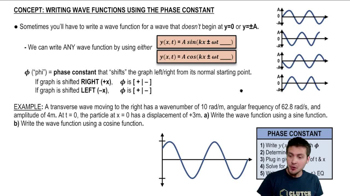
Determine the phase constant ϕ in Eq. 14–4 if, at t = 0, the oscillating mass is at 𝓍 = ― A.
Determine the phase constant ϕ in Eq. 14–4 if, at t = 0, the oscillating mass is at 𝓍 = A .
At t = 0, an 885-g mass at rest on the end of a horizontal spring (k = 184 N/m) is struck by a hammer which gives it an initial speed of 2.12 m/s. Determine the period and frequency of the motion.
A 0.25-kg mass at the end of a spring oscillates 3.2 times per second with an amplitude of 0.15 m. Determine the equation describing the motion of the mass, assuming that at t = 0, 𝓍 was a maximum.
