
A toy gyroscope consists of a 170-g disk with a radius of 5.5 cm mounted at the center of a thin axle 21 cm long (Fig. 11–42). The gyroscope spins at 45 rev/s. One end of its axle rests on a stand and the other end precesses horizontally about the stand. How long does it take the gyroscope to precess once around?
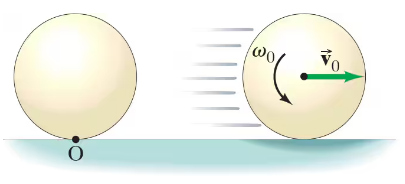
On a level billiards table a cue ball, initially at rest at point O on the table, is struck so that it leaves the cue stick with a center-of-mass speed v₀ and ω₀ a “reverse” spin of angular speed (see Fig. 11–41). A kinetic friction force acts on the ball as it initially skids across the table. Using conservation of angular momentum, find the critical angular speed ωC such that, if ω₀=ωC, kinetic friction will bring the ball to a complete (as opposed to momentary) stop.

Verified step by step guidance
Verified video answer for a similar problem:
Key Concepts
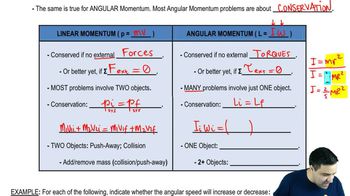
Conservation of Angular Momentum
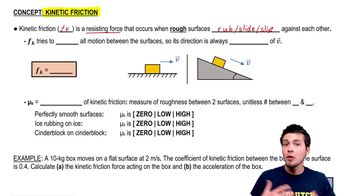
Kinetic Friction
Critical Angular Speed (ω_C)
Two ice skaters, both of mass 68 kg, approach on parallel paths 1.6 m apart. Both are moving at 3.5 m/s with their arms outstretched. They join hands as they pass, still maintaining their 1.6-m separation, and begin rotating about one another. Treat the skaters as particles with regard to their rotational inertia. If they now pull on each other’s hands, reducing their radius to half its original value, what is their common angular speed after reducing their radius?
On a level billiards table a cue ball, initially at rest at point O on the table, is struck so that it leaves the cue stick with a center-of-mass speed v₀ and ω₀ a “reverse” spin of angular speed (see Fig. 11–41). A kinetic friction force acts on the ball as it initially skids across the table. If ω₀ is 10% smaller than ωC , i.e., ω₀ = 0.90ωC, determine the ball’s cm velocity vCM when it starts to roll without slipping.
Suppose a 5.2 x 10¹⁰kg meteorite struck the Earth at the equator with a speed v = 2.2 x 10⁴ m/s, as shown in Fig. 11–38 and remained stuck. By what factor would this affect the rotational frequency of the Earth (1 rev/day)?
<IMAGE>
Two ice skaters, both of mass 68 kg, approach on parallel paths 1.6 m apart. Both are moving at 3.5 m/s with their arms outstretched. They join hands as they pass, still maintaining their 1.6-m separation, and begin rotating about one another. Treat the skaters as particles with regard to their rotational inertia. They now pull on each other’s hands, reducing their radius to half its original value. Calculate the change in kinetic energy for this process.
Suppose the solid wheel of Fig. 11–42 has a mass of 260 g and rotates at 85 rad/s; it has radius 6.0 cm and is mounted at the center of a horizontal thin axle 25 cm long. At what rate does the axle precess?
