

Ch. 10 - Rotational Motion
Giancoli Douglas - Physics for Scientists and Engineers 5th edition
Giancoli Douglas5th editionPhysics for Scientists and EngineersISBN: 9780137488179Not the one you use?Change textbook
Chapter 10, Problem 40

A softball player swings a bat, accelerating it from rest to 2.4 rev/s in a time of 0.20 s. Approximate the bat as a 0.90-kg uniform rod of length 0.95 m, and compute the torque the player applies to one end of it.

Verified step by step guidance
1
Step 1: Identify the given values and the quantities to calculate. The angular velocity \( \omega_f \) is 2.4 rev/s (convert to radians per second: \( \omega_f = 2.4 \times 2\pi \, \text{rad/s} \)), the initial angular velocity \( \omega_i \) is 0 rad/s, the time \( t \) is 0.20 s, the mass \( m \) of the bat is 0.90 kg, and the length \( L \) of the bat is 0.95 m. We need to calculate the torque \( \tau \).
Step 2: Calculate the angular acceleration \( \alpha \) using the kinematic equation for rotational motion: \( \alpha = \frac{\omega_f - \omega_i}{t} \). Substitute the known values of \( \omega_f \), \( \omega_i \), and \( t \) to find \( \alpha \).
Step 3: Determine the moment of inertia \( I \) of the bat. Since the bat is approximated as a uniform rod rotating about one end, the moment of inertia is given by \( I = \frac{1}{3} m L^2 \). Substitute the values of \( m \) and \( L \) to calculate \( I \).
Step 4: Use the rotational form of Newton's second law, \( \tau = I \alpha \), to calculate the torque. Substitute the values of \( I \) and \( \alpha \) into this equation to find \( \tau \).
Step 5: Ensure the units are consistent throughout the calculations (e.g., radians for angular velocity and acceleration) and verify the result for correctness.

Verified video answer for a similar problem:

This video solution was recommended by our tutors as helpful for the problem above.
Video duration:
6m
Was this helpful?

Key Concepts

Here are the essential concepts you must grasp in order to answer the question correctly.

Torque

Torque is a measure of the rotational force applied to an object, calculated as the product of the force and the distance from the pivot point (lever arm). It is expressed in Newton-meters (Nm) and determines how effectively a force can cause an object to rotate about an axis. In this scenario, the torque applied by the player to the bat is crucial for understanding how the bat accelerates.
Recommended video:
Guided course
08:55
Net Torque & Sign of Torque

Moment of Inertia

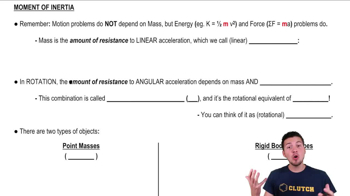
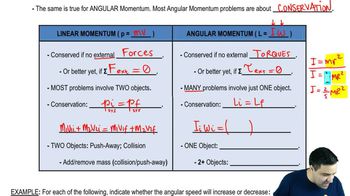
The moment of inertia is a property of a body that quantifies its resistance to rotational motion about an axis. For a uniform rod, it is calculated using the formula I = (1/3)ml², where m is the mass and l is the length of the rod. This concept is essential for determining how much torque is needed to achieve a certain angular acceleration, as it directly influences the relationship between torque, angular acceleration, and moment of inertia.
Recommended video:
Guided course
11:47
Intro to Moment of Inertia

Angular Acceleration

Angular acceleration is the rate of change of angular velocity over time, typically measured in radians per second squared (rad/s²). It indicates how quickly an object is speeding up or slowing down its rotation. In this question, calculating the angular acceleration of the bat is necessary to find the torque applied, as it relates to the moment of inertia and the net torque through the equation τ = Iα, where τ is torque, I is moment of inertia, and α is angular acceleration.
Recommended video:
Guided course
12:12
Conservation of Angular Momentum
Related Practice
Textbook Question

Let us treat a helicopter rotor blade as a long thin rod, as shown in Fig. 10–60. If each of the three rotor helicopter blades is 3.75 m long and has a mass of 135 kg, calculate the moment of inertia of the three rotor blades about the axis of rotation.

1436
views
Textbook Question

The bolts on the cylinder head of an engine require tightening to a torque of 95 m-N. If the six-sided bolt head is 15 mm across (Fig. 10–55), estimate the force applied near each of the six points by a wrench.

1146
views
Textbook Question

Calculate the moment of inertia of the array of point objects shown in Fig. 10–58 about the y axis, and the x axis. Assume m = 22kg, M = 3.2kg, and the objects are wired together by very light, rigid pieces of wire. The array is rectangular and is split through the middle by the x axis. About which axis would it be harder to accelerate this array?

1266
views
Textbook Question

Determine the net torque on the 2.0-m-long uniform beam shown in Fig. 10–56. All forces are shown. Calculate about point P at one end.

1756
views
Textbook Question

The forearm in Fig. 10–57 accelerates a 3.6-kg ball at 7.0 m/s² by means of the triceps muscle, as shown. Calculate the torque needed.

1640
views
Textbook Question

A dad pushes tangentially on a small hand-driven merry-go-round and is able to accelerate it from rest to a frequency of 15 rpm in 10.0 s. Assume the merry-go-round is a uniform disk of radius 2.5 m and has a mass of 330 kg, and two children (each with a mass of 25 kg) sit opposite each other on the edge. Calculate the torque required to produce the acceleration, neglecting frictional torque. What force is required at the edge?

1565
views