
Ch. 09 - Linear Momentum
Giancoli Douglas - Physics for Scientists and Engineers 5th edition
Giancoli Douglas5th editionPhysics for Scientists and EngineersISBN: 9780137488179Not the one you use?Change textbook
Chapter 9, Problem 100

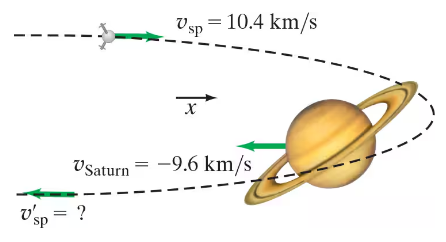
The gravitational slingshot effect. Figure 9–62 shows the planet Saturn moving in the negative 𝓍 direction at its orbital speed (with respect to the Sun) of 9.6 km/s. The mass of Saturn is 5.69 x 10²⁶ kg. A spacecraft with mass 825 kg approaches Saturn. When far from Saturn, it moves in the +𝓍 direction at 10.4 km/s. The gravitational attraction of Saturn (a conservative force) acting on the spacecraft causes it to swing around the planet (orbit shown as dashed line) and head off in the opposite direction. Using momentum conservation in one dimension, estimate the final speed of the spacecraft after it is far enough away to be considered free of Saturn’s gravitational pull. Assume the spacecraft does not affect the orbit of Saturn whose mass is so much larger.
Diagram illustrating a spacecraft's trajectory around Saturn, showing speeds and direction of motion during a gravitational slingshot.

Verified step by step guidance
1
Identify the principle of conservation of momentum: In this problem, the total momentum of the system (Saturn + spacecraft) is conserved because no external forces act on the system in the 𝓍 direction.
Write the expression for the total initial momentum of the system: The initial momentum is the sum of the momentum of Saturn and the spacecraft. Use the formula for momentum, p = mv, where m is mass and v is velocity. The initial momentum is: \( p_{initial} = m_{Saturn}v_{Saturn} + m_{spacecraft}v_{spacecraft} \).
Write the expression for the total final momentum of the system: After the interaction, the spacecraft moves in the opposite direction, and Saturn continues in its original direction. The final momentum is: \( p_{final} = m_{Saturn}v_{Saturn}' + m_{spacecraft}v_{spacecraft}' \), where \( v_{Saturn}' \) and \( v_{spacecraft}' \) are the final velocities of Saturn and the spacecraft, respectively.
Apply the conservation of momentum: Set the total initial momentum equal to the total final momentum: \( m_{Saturn}v_{Saturn} + m_{spacecraft}v_{spacecraft} = m_{Saturn}v_{Saturn}' + m_{spacecraft}v_{spacecraft}' \). Since the mass of Saturn is much larger than the spacecraft, assume \( v_{Saturn}' \approx v_{Saturn} \).
Solve for the final velocity of the spacecraft: Rearrange the equation to isolate \( v_{spacecraft}' \): \( v_{spacecraft}' = \frac{m_{Saturn}(v_{Saturn} - v_{Saturn}') + m_{spacecraft}v_{spacecraft}}{m_{spacecraft}} \). Substitute the given values for masses and velocities to calculate the final speed of the spacecraft.

Verified video answer for a similar problem:

This video solution was recommended by our tutors as helpful for the problem above.
Video duration:
6m
Was this helpful?

Key Concepts

Here are the essential concepts you must grasp in order to answer the question correctly.

Gravitational Slingshot Effect

The gravitational slingshot effect, or gravity assist, is a maneuver used by spacecraft to gain speed and change direction by passing close to a massive body, like a planet. As the spacecraft approaches the planet, it is pulled in by the planet's gravity, gaining kinetic energy and speed. When it swings around the planet, it is flung out in a new direction, often at a higher velocity than it had before, effectively using the planet's orbital motion to increase its own.
Recommended video:
Guided course
07:40
The Doppler Effect

Conservation of Momentum

Conservation of momentum is a fundamental principle in physics stating that the total momentum of a closed system remains constant if no external forces act on it. In the context of the spacecraft and Saturn, the momentum before and after the interaction must be equal. This principle allows us to calculate the final speed of the spacecraft after it has been influenced by Saturn's gravitational pull, as the momentum transferred during the encounter must account for both the spacecraft and the planet.
Recommended video:
Guided course
05:58
Conservation Of Momentum

Massive Body Influence

In gravitational interactions, the mass of the objects involved plays a crucial role in determining the outcome of their interaction. In this scenario, Saturn's mass is significantly larger than that of the spacecraft, allowing it to exert a strong gravitational force without being noticeably affected in return. This disparity means that the spacecraft can be treated as a perturbation to Saturn's motion, simplifying the calculations and allowing us to focus on the spacecraft's change in velocity due to the gravitational slingshot effect.
Recommended video:
Guided course
08:42
Free-Body Diagrams