
Ch. 09 - Linear Momentum
Giancoli Douglas - Physics for Scientists and Engineers 5th edition
Giancoli Douglas5th editionPhysics for Scientists and EngineersISBN: 9780137488179Not the one you use?Change textbook
Chapter 9, Problem 85b

A 5.5-kg object moving in the +𝓍 direction at 6.5 m/s collides head-on with an 8.0-kg object moving in the ―𝓍 direction at 4.0 m/s. Determine the final velocity of each object if the collision is elastic.

Verified step by step guidance
1
Step 1: Understand the problem. This is a two-object collision problem where the collision is elastic. In an elastic collision, both momentum and kinetic energy are conserved. The goal is to find the final velocities of both objects after the collision.
Step 2: Write the equation for conservation of momentum. The total momentum before the collision equals the total momentum after the collision. The equation is: m1v1i + m2v2i = m1v1f + m2v2f, where m1 and m2 are the masses of the objects, v1i and v2i are their initial velocities, and v1f and v2f are their final velocities.
Step 3: Write the equation for conservation of kinetic energy. Since the collision is elastic, the total kinetic energy before the collision equals the total kinetic energy after the collision. The equation is: 1/2 m1v1i2 + 1/2 m2v2i2 = 1/2 m1v1f2 + 1/2 m2v2f2. Simplify this equation by canceling out the 1/2 factor.
Step 4: Solve the system of equations. You now have two equations: one from momentum conservation and one from kinetic energy conservation. Substitute the known values (m1 = 5.5, m2 = 8.0, v1i = 6.5, v2i = -4.0) into the equations. Solve for the two unknowns, v1f and v2f, using algebraic methods or substitution.
Step 5: Interpret the results. Once you solve for v1f and v2f, check that they satisfy both the momentum and kinetic energy conservation equations. These final velocities represent the speeds and directions of the objects after the elastic collision.

Verified video answer for a similar problem:

This video solution was recommended by our tutors as helpful for the problem above.
Video duration:
11m
Was this helpful?

Key Concepts

Here are the essential concepts you must grasp in order to answer the question correctly.

Conservation of Momentum

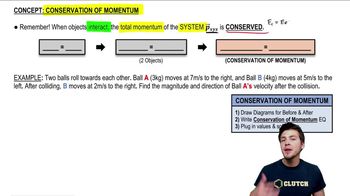
In an isolated system, the total momentum before a collision is equal to the total momentum after the collision. This principle is crucial for analyzing collisions, as it allows us to set up equations based on the masses and velocities of the colliding objects to find their final velocities.
Recommended video:
Guided course
05:58
Conservation Of Momentum

Elastic Collision

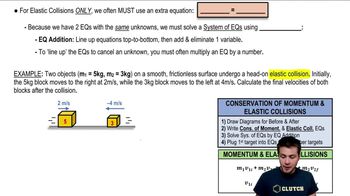
An elastic collision is one in which both momentum and kinetic energy are conserved. This means that not only do the objects bounce off each other without losing energy, but the total kinetic energy before and after the collision remains the same, which is essential for solving problems involving elastic collisions.
Recommended video:
Guided course
08:56
Intro To Elastic Collisions

Kinetic Energy

Kinetic energy is the energy an object possesses due to its motion, calculated using the formula KE = 1/2 mvΒ², where m is mass and v is velocity. In elastic collisions, the conservation of kinetic energy must be considered alongside momentum to determine the final velocities of the colliding objects.
Recommended video:
Guided course
06:07
Intro to Rotational Kinetic Energy
Related Practice
Textbook Question

A gun fires a bullet vertically into a 1.40-kg block of wood at rest on a thin horizontal sheet, Fig. 9–54. If the bullet has a mass of 15.0 g and a speed of 230 m/s, how high will the block rise into the air after the bullet becomes embedded in it?

1646
views
Textbook Question

Astronomers estimate that a 2.0-km-diameter asteroid collides with the Earth once every million years. The collision could pose a threat to life on Earth. Assume a spherical asteroid has a mass of 3200 kg for each cubic meter of volume and moves toward the Earth at 15 km/s. How much destructive energy could be released when it embeds itself in the Earth?

1773
views
Textbook Question

A 0.145-kg baseball pitched horizontally at 35.0 m/s strikes a bat and pops straight up to a height of 31.5 m. If the contact time between bat and ball is 2.5 ms, calculate the average force between the ball and bat during contact.

1960
views
Textbook Question

A rifle is aimed at a 2.0-kg block of wood along an inclined plane making an angle of 25Β°, as shown in Fig. 9–59. A 9.5-g bullet is fired at 760 m/s and becomes embedded in the block. How far up the incline does the block/bullet slide?

(a) Ignore the friction.

(b) Assume ΞΌβ‚– = 0.33.

82
views
Textbook Question

A 5.5-kg object moving in the +𝓍 direction at 6.5 m/s collides head-on with an 8.0-kg object moving in the ―𝓍 direction at 4.0 m/s. Determine the final velocity of each object if the 5.5-kg object is at rest after the collision.

1172
views
Textbook Question

A 5.5-kg object moving in the +𝓍 direction at 6.5 m/s collides head-on with an 8.0-kg object moving in the ―𝓍 direction at 4.0 m/s. Determine the final velocity of each object if the objects stick together.

1395
views