
(II) Suppose that three main-sequence stars could undergo the three changes represented by the three arrows, A, B, and C, in the H–R diagram of Fig. 44–35. For each case, describe the changes in temperature, intrinsic luminosity, and size.
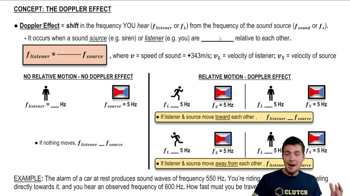
Starting from Eq. 44–3, show that the Doppler shift in wavelength is ∆λ/λᵣₑₛₜ ≈ v/c (Eq. 44–6) for v ≪ c. [Hint: Use the binomial expansion.]
Verified step by step guidance
Verified video answer for a similar problem:
Key Concepts
Doppler Effect
Wavelength Shift
Binomial Expansion
We saw earlier (Chapter 19) that the rate energy reaches the Earth from the Sun (the “solar constant”) is about 1.3 x 10³ W/m². What is (a) the apparent brightness b of the Sun, and (b) the intrinsic luminosity L of the Sun?
(a) In order to measure distances with parallax at 100 ly, what minimum angular resolution (in degrees) is needed?
(b) What diameter mirror or lens would be needed?
If a galaxy is traveling away from us at 2.2% of the speed of light, roughly how far away is it?
Calculate the peak wavelength of the CMB at 1.0 s after the birth of the universe. In what part of the EM spectrum is this radiation?
At approximately what time had the universe cooled below the threshold temperature for producing (a) kaons (M ≈ 500 MeV/ c²), (b) Y (M ≈ 9500 MeV/c²), and (c) muons (M ≈ 100 MeV/c²)?
