
Ch. 26 - DC Circuits
Giancoli Douglas - Physics for Scientists and Engineers 5th edition
Giancoli Douglas5th editionPhysics for Scientists and EngineersISBN: 9780137488179Not the one you use?Change textbook
Chapter 25, Problem 26

[In these Problems neglect the internal resistance of a battery unless the Problem refers to it.]


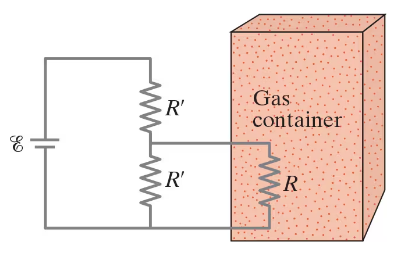
(III) You are designing a wire resistance heater to heat an enclosed container of gas. For the apparatus to function properly, this heater must transfer heat to the gas at a very constant rate. While in operation, the resistance of the heater will always be close to the value R = R₀, but may fluctuate slightly causing its resistance to vary a small amount ∆R ( << R₀ ). To maintain the heater at constant power, you design the circuit shown in Fig. 26–50, which includes two resistors, each of resistance R′. Determine the value for R′ so that the heater power P will remain constant even if its resistance R fluctuates by a small amount. [Hint: If ∆R << R₀ , then ΔPΔRdPdRR=R0\(\Delta\) P\(\approx\) \(\Delta\) R\(\left\). \(\frac{dP}{dR}\]\right\)|_{R=R_{0}}]

Verified step by step guidance
1
Step 1: Begin by recalling the formula for power dissipated in a resistor: \( P = \frac{V^2}{R} \), where \( V \) is the voltage across the resistor and \( R \) is its resistance. In this problem, the goal is to ensure that the power \( P \) remains constant even if the resistance \( R \) fluctuates slightly.
Step 2: Analyze the circuit shown in Fig. 26–50. The heater is connected in parallel with two resistors, each of resistance \( R' \). The total resistance of the parallel combination can be expressed as \( R_{total} = \frac{1}{\frac{1}{R} + \frac{1}{2R'}} \). This total resistance determines the current through the circuit and the voltage across the heater.
Step 3: To maintain constant power, the derivative of power \( P \) with respect to \( R \) must be zero when \( R = R₀ \). Use the hint provided: \( \Delta P \approx \Delta R \cdot \frac{dP}{dR} \big|_{R = R₀} \). Calculate \( \frac{dP}{dR} \) using the expression for \( P \) and substitute \( R_{total} \) into the equation.
Step 4: Simplify the derivative \( \frac{dP}{dR} \) and set it equal to zero at \( R = R₀ \). This will yield a relationship between \( R₀ \) and \( R' \). Solve for \( R' \) to find the value that ensures constant power.
Step 5: Conclude that the value of \( R' \) depends on the specific relationship derived in Step 4. This ensures that the circuit compensates for small fluctuations in \( R \), maintaining constant power output to the heater.

Verified video answer for a similar problem:

This video solution was recommended by our tutors as helpful for the problem above.
Video duration:
11m
Was this helpful?

Key Concepts

Here are the essential concepts you must grasp in order to answer the question correctly.

Ohm's Law

Ohm's Law states that the current (I) flowing through a conductor between two points is directly proportional to the voltage (V) across the two points and inversely proportional to the resistance (R) of the conductor. This relationship is expressed mathematically as V = IR. Understanding this law is crucial for analyzing electrical circuits, as it helps determine how changes in resistance affect current and voltage, which is essential for maintaining constant power in the heater.

Power in Electrical Circuits

The power (P) consumed by an electrical device is defined as the rate at which it converts electrical energy into another form of energy, such as heat. It can be calculated using the formula P = IV, where I is the current and V is the voltage. In the context of the heater, maintaining constant power despite fluctuations in resistance is vital for ensuring consistent heating, which is why understanding how power relates to resistance and current is important.

Resistor Configuration

In electrical circuits, resistors can be arranged in series or parallel configurations, which affect the total resistance and current flow. For the heater design, using two resistors of resistance R′ allows for adjustments to the overall resistance in the circuit. This configuration is key to compensating for small fluctuations in the heater's resistance (∆R), ensuring that the power remains constant by effectively managing the total resistance in the circuit.
Related Practice
Textbook Question

[In these Problems neglect the internal resistance of a battery unless the Problem refers to it.]


(II) A power supply has a fixed output voltage of 12.0 V, but you need VT = 3.0 V output for an experiment. (a) Using the voltage divider shown in Fig. 26–47, what should R₂ be if R₁ is 16.5 Ω? (b) What will the terminal voltage VT be if you connect a load to the 3.0-V output, assuming the load has a resistance of 7.0Ω?

141
views
Textbook Question

(III) If the 25-Ω resistor in Fig. 26–59 is shorted out (resistance = 0 ), what then would be the current through the 15-Ω resistor?

857
views
Textbook Question

(II) Determine the magnitudes and directions of the currents in each resistor shown in Fig. 26–57. The batteries have emfs of ε1 = 9.0V and ε2 = 12.0V and the resistors have values of R1 = 25 Ω, R2 = 48 Ω, and R3 = 35 Ω.

(a) Ignore internal resistance of the batteries.

(b) Assume each battery has internal resistance r = 1.0 Ω.

911
views
Textbook Question

(II) (a) What is the potential difference between points a and d in Fig. 26–55 (similar to Fig. 26–12, Example 26–8), and (b) what is the terminal voltage of each battery?

886
views
Textbook Question

[In these Problems neglect the internal resistance of a battery unless the Problem refers to it.]


(II) What is the net resistance of the circuit connected to the battery in Fig. 26–46?

776
views
Textbook Question

[In these Problems neglect the internal resistance of a battery unless the Problem refers to it.]


(II) Determine the current through each resistor.

757
views