One mole of atoms consists of 6.02 x 10²³ individual atoms. If a mole of atoms were spread uniformly over the Earth's surface, how many atoms would there be per square meter?
Ch. 01 - Introduction, Measurement, Estimating
Giancoli Douglas5th editionPhysics for Scientists and EngineersISBN: 9780137488179Not the one you use?Change textbook
Chapter 1, Problem 96b
Waves on the surface of the ocean do not depend significantly on the properties of water such as density or surface tension. The primary 'return force' for water piled up in the wave crests is due to the gravitational attraction of the Earth. Thus the speed v (m/s) of ocean waves depends on the acceleration due to gravity g. It is reasonable to expect that υ might also depend on water depth h and the wave's wavelength λ. Assume the wave speed is given by the functional form v = Cgᵅ hᵝ λᵞ, where α, β, , and C are numbers without dimension. In shallow water, the speed of surface waves is found experimentally to be independent of the wavelength (i.e., γ = 0 in our assumed equation above for v). Using only dimensional analysis, determine the formula for the speed of waves in shallow water.
Verified step by step guidance1
Step 1: Begin by analyzing the given functional form of the wave speed: v = Cgᵅ hᵝ λᵞ. Here, v is the wave speed (m/s), g is the acceleration due to gravity (m/s²), h is the water depth (m), and λ is the wavelength (m). The constants α, β, and γ are dimensionless exponents, and C is a dimensionless constant.
Step 2: In shallow water, it is stated that the wave speed is independent of the wavelength, which implies γ = 0. This simplifies the functional form to v = Cgᵅ hᵝ.
Step 3: Perform dimensional analysis. The dimensions of v are [v] = L/T (length per time), the dimensions of g are [g] = L/T² (acceleration), and the dimensions of h are [h] = L (length). Substitute these into the simplified equation: [v] = [C][g]ᵅ[h]ᵝ.
Step 4: Since C is dimensionless, it does not contribute to the dimensions. Substitute the dimensions of g and h into the equation: L/T = (L/T²)ᵅ × (L)ᵝ. Expand the exponents: L/T = Lᵅ/T²ᵅ × Lᵝ.
Step 5: Equate the powers of L and T on both sides of the equation. For L: 1 = α + β. For T: -1 = -2α. Solve these equations simultaneously to find α = 1/2 and β = 1/2. Thus, the formula for the wave speed in shallow water is v = C√(gh).

Verified video answer for a similar problem:
This video solution was recommended by our tutors as helpful for the problem above.
Was this helpful?
Key Concepts
Here are the essential concepts you must grasp in order to answer the question correctly.
Dimensional Analysis
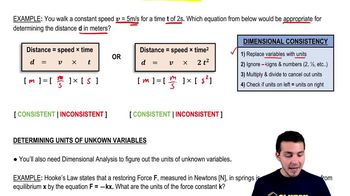
Dimensional analysis is a mathematical technique used to convert one set of units to another and to derive relationships between physical quantities based on their dimensions. It involves checking the consistency of equations by ensuring that both sides have the same dimensions, which helps in identifying the fundamental relationships between variables. This method is particularly useful in physics for simplifying complex problems and deriving formulas without detailed knowledge of the underlying phenomena.
Recommended video:
Guided course
Dimensional Analysis
Wave Speed in Shallow Water
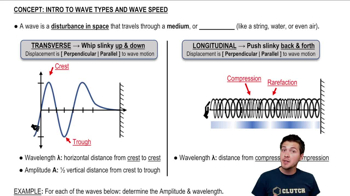
In shallow water, the speed of surface waves is influenced primarily by the water depth rather than the wavelength. This phenomenon occurs because, in shallow conditions, the wave's interaction with the bottom of the body of water becomes significant, leading to a dependence on depth. The relationship can be expressed as v = k√(gh), where k is a constant, g is the acceleration due to gravity, and h is the water depth, indicating that wave speed increases with greater depth.
Recommended video:
Guided course
Intro to Waves and Wave Speed
Non-Dimensional Parameters
Non-dimensional parameters are quantities that have no units and are used to simplify the analysis of physical systems. In the context of wave speed, parameters like α, β, and γ in the equation v = Cgᵅ hᵝ λᵞ help to express the relationships between variables without the influence of their units. By setting γ = 0 for shallow water, we can focus on the remaining parameters to derive a simplified expression for wave speed that highlights the dependence on gravity and water depth.
Recommended video:
Guided course
Dimensional Analysis
Related Practice
Textbook Question
1272
views
Textbook Question
The following formula estimates an average person's lung capacity V (in liters, where 1 L = 10³ cm³): V = 4.1H ― 0.018A ―2.7, where H and A are the person's height (in meters) and age (in years), respectively. In this formula, what are the units of the numbers 4.1, 0.018, and 2.7?
1801
views
Textbook Question
Show that the following combination of the three fundamental constants of nature that we used in Example 1–10 (that is G, c, and h) forms a quantity with the dimensions of time: tₚ = /c⁵. This quantity, tₚ, is called the Planck time and is thought to be the earliest time, after the creation of the Universe, at which the currently known laws of physics can be applied.
3091
views