Textbook Question
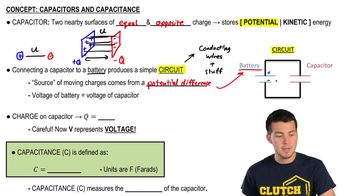
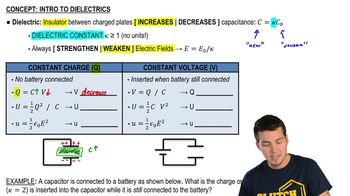
What is the capacitance of a pair of circular plates with a radius of 5.0 cm separated by 2.3 mm of mica?
1695
views

 Giancoli Douglas 5th editionCh. 24 - Capacitance, Dielectrics, Electric Energy, Storage Problem 84
 Verified step by step guidance
 08:02
08:02
 06:25
06:25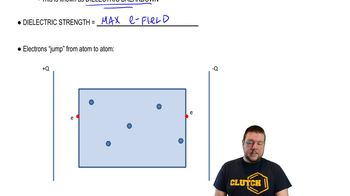 04:32
04:32What is the capacitance of a pair of circular plates with a radius of 5.0 cm separated by 2.3 mm of mica?
A parallel-plate capacitor with plate area 2.0 cm² and air-gap separation 0.50 mm is connected to a 12-V battery, and fully charged. The battery is then disconnected. What is the charge on the capacitor?
Capacitors can be used as “electric charge counters.” Consider an initially uncharged capacitor of capacitance C with its bottom plate grounded and its top plate connected to a source of electrons. If N electrons flow onto the capacitor’s top plate, show that the resulting potential difference V across the capacitor is directly proportional to N.
The capacitor shown in Fig. 24–34 is connected to an 80.0-V battery. Calculate (and sketch) the electric field everywhere between the capacitor plates. Find both the free charge on each capacitor plate and the induced charge on the faces of the glass dielectric plate.
A 3500-pF air-gap capacitor is connected to an 18-V battery. If a piece of mica fills the space between the plates, how much charge will flow from the battery?
A parallel-plate capacitor with plate area 2.0 cm² and air-gap separation 0.50 mm is connected to a 12-V battery, and fully charged. The battery is then disconnected. The plates are now pulled to a separation of 0.85 mm. What is the charge on the capacitor now?