
Textbook Question
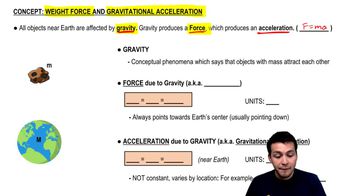
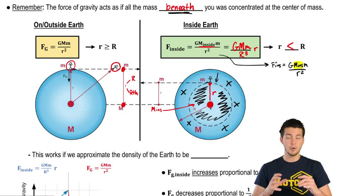
Use the binomial expansion to show that the value of g is altered by approximately at a height ∆r above the Earth’s surface, where rE is the radius of the Earth, as long as ∆r ≪ rE.
1481
views

 Verified step by step guidance
 07:32
07:32
 9:26
9:26 08:55
08:55Use the binomial expansion to show that the value of g is altered by approximately at a height ∆r above the Earth’s surface, where rE is the radius of the Earth, as long as ∆r ≪ rE.
An inclined plane, fixed to the inside of an elevator, makes a 38° angle with the floor. A mass m slides on the plane without friction. What is its acceleration relative to the plane if the elevator moves upward at constant speed?
Four masses are arranged as shown in Fig. 6–28. Determine the x and y components of the gravitational force on the mass at the origin (m). Write the force in vector notation (î, ĵ).
An inclined plane, fixed to the inside of an elevator, makes a 38° angle with the floor. A mass m slides on the plane without friction. What is its acceleration relative to the plane if the elevator accelerates downward at 0.50 g?
An inclined plane, fixed to the inside of an elevator, makes a 38° angle with the floor. A mass m slides on the plane without friction. What is its acceleration relative to the plane if the elevator falls freely?