
Ch. 23 - Electric Potential
Giancoli Douglas - Physics for Scientists and Engineers 5th edition
Giancoli Douglas5th editionPhysics for Scientists and EngineersISBN: 9780137488179Not the one you use?Change textbook
Chapter 22, Problem 45b

Calculate the electric potential due to a tiny dipole whose dipole moment is 4.8 x 10⁻³⁰ Cm at a point 4.1 x 10⁻⁹ m away if this point is 45° above the axis but nearer the positive charge.

Verified step by step guidance
1
Understand the problem: The electric potential due to a dipole at a point in space depends on the dipole moment, the distance from the dipole, and the angle between the dipole axis and the line connecting the dipole to the point. The formula for the potential is \( V = \frac{1}{4\pi\epsilon_0} \cdot \frac{p \cos\theta}{r^2} \), where \( p \) is the dipole moment, \( r \) is the distance, \( \theta \) is the angle, and \( \epsilon_0 \) is the permittivity of free space.
Identify the given values: The dipole moment \( p = 4.8 \times 10^{-30} \; \text{C·m} \), the distance \( r = 4.1 \times 10^{-9} \; \text{m} \), and the angle \( \theta = 45^\circ \). The permittivity of free space is \( \epsilon_0 = 8.85 \times 10^{-12} \; \text{C}^2/\text{N·m}^2 \).
Convert the angle \( \theta \) to radians if necessary, as trigonometric functions in physics often use radians. \( \theta = 45^\circ = \frac{\pi}{4} \; \text{radians} \).
Substitute the known values into the formula for the electric potential: \( V = \frac{1}{4\pi \epsilon_0} \cdot \frac{p \cos\theta}{r^2} \). Replace \( p \), \( \theta \), \( r \), and \( \epsilon_0 \) with their respective values.
Simplify the expression step by step: First calculate \( \cos\theta \), then compute \( r^2 \), and finally evaluate the constants \( \frac{1}{4\pi \epsilon_0} \). Multiply these results together to find the electric potential \( V \).

Verified video answer for a similar problem:

This video solution was recommended by our tutors as helpful for the problem above.
Video duration:
3m
Was this helpful?

Key Concepts

Here are the essential concepts you must grasp in order to answer the question correctly.

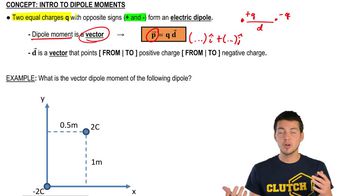
Electric Dipole Moment

The electric dipole moment is a vector quantity that represents the separation of positive and negative charges in a system. It is defined as the product of the charge magnitude and the distance between the charges. In this case, the dipole moment of 4.8 x 10⁻³⁰ C·m indicates the strength and orientation of the dipole, which is crucial for calculating the electric potential at a given point.
Recommended video:
Guided course
03:08
Intro To Dipole Moment

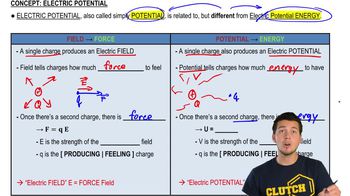
Electric Potential Due to a Dipole

The electric potential (V) due to a dipole at a point in space is determined by the dipole moment and the distance from the dipole. The formula for the potential at an angle θ from the dipole axis is given by V = (1/4πε₀) * (p·cosθ)/r², where p is the dipole moment, r is the distance from the dipole, and ε₀ is the permittivity of free space. This relationship highlights how the potential varies with both distance and angle.
Recommended video:
Guided course
07:33
Electric Potential

Coordinate System and Angles

Understanding the coordinate system and angles is essential for solving problems involving electric fields and potentials. In this scenario, the angle of 45° above the axis indicates the spatial orientation of the point where the potential is being calculated. This angle affects the cosine component in the potential formula, influencing the resulting value of the electric potential at that specific location.
Recommended video:
Guided course
05:17
Coordinates of Center of Mass of 4 objects