
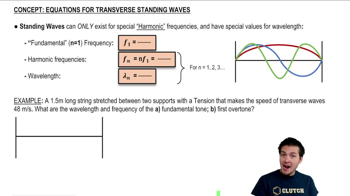
A guitar string is 91 cm long and has a mass of 3.2 g. The vibrating portion of the string from the bridge to the support post is ℓ = 64cm and the string is under a tension of 520 N. What are the frequencies of the fundamental and first two overtones?
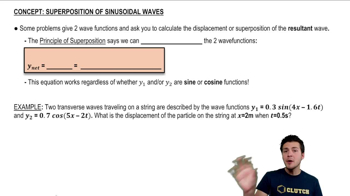
Suppose two linear waves of equal amplitude and frequency have a phase difference ϕ as they travel in the same medium. They can be represented by: D₁ = A sin (kx - ωt); D₂ = A sin ( kx - ωt + ϕ). Describe the resultant wave, by equation and in words, if ϕ = π/2.
Verified step by step guidance
Verified video answer for a similar problem:
Key Concepts
Wave Superposition
Phase Difference
Resultant Wave Equation
A particular string resonates in four loops at a frequency of 320 Hz. Name at least three other frequencies at which it will resonate. What is each called?
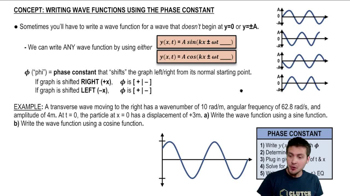
Write the equation for the wave in Problem 29 traveling to the right, if its amplitude is 0.020 cm, and D = - 0.020 cm, at t = 0 and x = 0.
Suppose two linear waves of equal amplitude and frequency have a phase difference ϕ as they travel in the same medium. They can be represented by: D₁ = A sin (kx - ωt); D₂ = A sin ( kx - ωt + ϕ). What is the amplitude of this resultant wave? Is the wave purely sinusoidal, or not?
The speed of waves on a string is 96 m/s. If the frequency of standing waves is 435 Hz, how far apart are two adjacent nodes?
A transverse wave on a cord is given by D(x,t) = 0.12 sin (3.0x - 15.0t), where D and x are in meters and t is in seconds. At t = 0.20s, what are the displacement, velocity, and acceleration of a point on the cord where x = 0.60 m?
