
Textbook Question
(III) Use the result of Problem 44 to find the magnetic field at point P in Fig. 28–53 due to the current in the square loop.
583
views

 Verified step by step guidance
(III) Use the result of Problem 44 to find the magnetic field at point P in Fig. 28–53 due to the current in the square loop.
Helmholtz coils are two identical circular coils having the same radius 𝑅 and the same number of turns N, separated by a distance equal to the radius 𝑅 and carrying the same dc current I in the same direction. (See Fig. 28–61.) They are used in scientific instruments to generate nearly uniform magnetic fields. (They can be seen in the photo, Fig. 27–19.) (a) Determine the magnetic field B at points 𝓍 along the line joining their centers. Let 𝓍 = 0 at the center of one coil, and 𝓍 = 𝑅 at the center of the other. (b) Show that the field midway between the coils is particularly uniform by showing that dB/d𝓍 = 0 and d²B/d𝓍² = 0 at the midpoint between the coils. (c) If 𝑅 = 10.0 cm, N = 85 turns and I = 3.0 A, what is the field at the midpoint between the coils, 𝓍 = 𝑅/2?
A long horizontal wire carries a current of 42 A. A second wire, made of 1.00-mm-diameter copper wire and parallel to the first, is kept in suspension magnetically 5.0 cm below (Fig. 28–60). (a) Determine the magnitude and direction of the current in the lower wire. (b) Is the lower wire in stable equilibrium? (c) Repeat parts (a) and (b) if the second wire is suspended 5.0 cm above the first due to the first’s magnetic field.
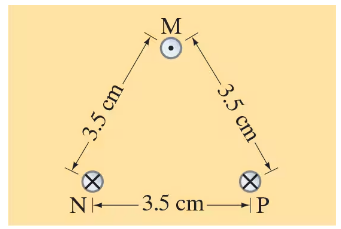
In Fig. 28–57 the top wire is 1.00-mm-diameter copper wire and is suspended in air due to the two magnetic forces from the bottom two wires. The current is 35.0 A in each of the two bottom wires. Calculate the required current in the suspended wire (M).
(III) A square loop of wire, of side d, carries a current I. (a) Determine the magnetic field B at points on a line (call it the 𝓍 axis) perpendicular to the plane of the square which passes through the center of the square (Fig. 28–56). Express B as a function of 𝓍, the distance from the center of the square. (b) For 𝓍 ≫ d, does the square appear to be a magnetic dipole? If so, what is its dipole moment?
(II) Consider a straight section of wire of length d, as in Fig. 28–51, which carries a current I. (a) Show that the magnetic field at a point P a distance 𝑅 from the wire along its perpendicular bisector is
(b) Show that this is consistent with Example 28–10 for an infinite wire.