
Ch. 12 - Static Equilibrium; Elasticity and Fracture
Giancoli Douglas - Physics for Scientists and Engineers 5th edition
Giancoli Douglas5th editionPhysics for Scientists and EngineersISBN: 9780137488179Not the one you use?Change textbook
Chapter 12, Problem 53

A steel cable is to support an elevator whose total (loaded) mass is not to exceed 3100 kg. If the maximum acceleration of the elevator is 1.8 m/s² , calculate the diameter of cable required. Assume a safety factor of 8.0.

Verified step by step guidance
1
Determine the maximum force the cable must support using Newton's second law: \( F_{max} = m(a + g) \), where \( m \) is the mass of the elevator (3100 kg), \( a \) is the maximum acceleration (1.8 m/s²), and \( g \) is the acceleration due to gravity (9.8 m/s²).
Apply the safety factor to the maximum force: \( F_{safe} = F_{max} \times \text{safety factor} \). The safety factor is given as 8.0.
Relate the safe force to the tensile strength of the steel cable: \( F_{safe} = \sigma \cdot A \), where \( \sigma \) is the tensile strength of steel (a typical value is around 500 \( \text{MPa} \), but confirm the exact value if provided), and \( A \) is the cross-sectional area of the cable.
Express the cross-sectional area \( A \) in terms of the cable's diameter \( d \): \( A = \frac{\pi d^2}{4} \). Substitute this into the equation for \( F_{safe} \) to solve for \( d \): \( d = \sqrt{\frac{4F_{safe}}{\pi \sigma}} \).
Substitute the known values for \( F_{safe} \), \( \pi \), and \( \sigma \) into the equation to calculate the required diameter \( d \). Ensure the units are consistent throughout the calculation (e.g., convert \( \text{MPa} \) to \( \text{N/m}^2 \) if necessary).

Verified video answer for a similar problem:

This video solution was recommended by our tutors as helpful for the problem above.
Video duration:
8m
Was this helpful?

Key Concepts

Here are the essential concepts you must grasp in order to answer the question correctly.

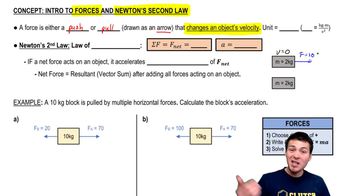
Newton's Second Law of Motion

Newton's Second Law states that the force acting on an object is equal to the mass of that object multiplied by its acceleration (F = ma). In this context, the total force required to support the elevator includes both the gravitational force and the force due to acceleration. Understanding this law is crucial for calculating the tension in the cable needed to support the elevator's mass while accounting for its acceleration.
Recommended video:
Guided course
06:54
Intro to Forces & Newton's Second Law

Tension in a Cable

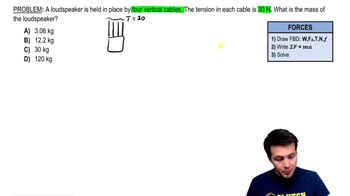
Tension is the force transmitted through a cable when it is pulled tight by forces acting from opposite ends. In this scenario, the tension in the steel cable must be sufficient to support the weight of the elevator and provide the necessary upward acceleration. The tension can be calculated by considering both the weight of the elevator and the additional force required for acceleration, which is essential for determining the cable's specifications.
Recommended video:
Guided course
03:25
Multiple Cables on a Loudspeaker

Safety Factor

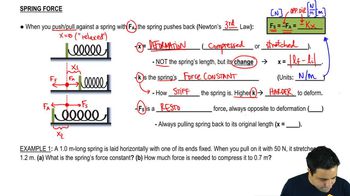
The safety factor is a design criterion that provides a margin of safety in engineering applications. It is defined as the ratio of the maximum load a structure can handle to the intended load. In this case, a safety factor of 8.0 means the cable must be able to support eight times the calculated tension to ensure safety under maximum load conditions. This concept is vital for ensuring that the cable can withstand unexpected stresses without failure.
Recommended video:
Guided course
15:52
Intro to Springs
Related Practice
Textbook Question

A 50-story building is being planned. It is to be 180.0 m high with a base 46.0 m by 76.0 m. Its total mass will be about 1.8 x 10⁷ kg, and its weight therefore about 1.8 x 10⁸ N. Suppose a 200-km/h wind exerts a force of 950N/m² over the 76.0-m-wide face (Fig. 12–86). Calculate the torque about the potential pivot point, the rear edge of the building (where FE\(\overrightarrow{F_{E}\)} acts in Fig. 12–86), and determine whether the building will topple. Assume the total force of the wind acts at the midpoint of the building’s face, and that the building is not anchored in bedrock. [Hint: FE\(\overrightarrow{F_{E}\)} in Fig. 12–86 represents the force that the Earth would exert on the building in the case where the building would just begin to tip.]

1359
views
Textbook Question

Assume the supports of the uniform cantilever shown in Fig. 12–79 (m = 2900 kg) are made of wood. Calculate the minimum cross-sectional area required of each, assuming a safety factor of 9.0.

1755
views
Textbook Question

The subterranean tension ring that surrounds the dome in Fig. 12–39 exerts the balancing horizontal force on the abutments for the dome and is 36-sided, so each segment makes a 10° angle with the adjacent one (Fig. 12–83). Calculate the tension F that must exist in each segment so that the required force of 4.2 x 10⁵ N can be exerted at each corner (Example 12–14).

1462
views
Textbook Question

A heavy load Mg = 62.0 kN hangs at point E of the single cantilever truss shown in Fig. 12–81. Use a torque equation for the truss as a whole to determine the tension FT in the support cable, and then determine the force FA\(\overrightarrow{F_{A}\)} on the truss at pin A. Neglect the weight of the trusses, which is small compared to the load.

1353
views
1
rank
Textbook Question

A marble column of cross-sectional area 1.4m² supports a mass of 22,000 kg. By how much is the column shortened if it is 8.6 m high?

1795
views
Textbook Question

A 15-cm-long tendon was found to stretch 3.7 mm by a force of 13.4 N. The tendon was approximately round with an average diameter of 8.5 mm. Calculate Young’s modulus of this tendon.

70
views