Ch. 26 - DC Circuits
Giancoli Douglas - Physics for Scientists and Engineers 5th edition
Giancoli Douglas5th editionPhysics for Scientists and EngineersISBN: 9780137488179Not the one you use?Change textbook
Chapter 25, Problem 16a

[In these Problems neglect the internal resistance of a battery unless the Problem refers to it.]


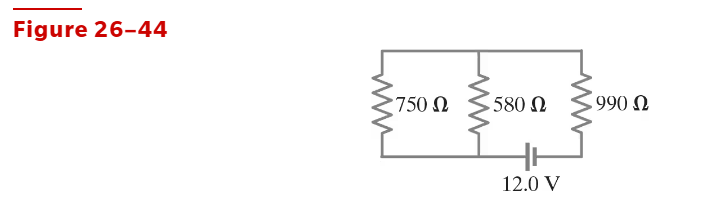
(II) Determine the equivalent resistance of the circuit shown in Fig. 26–44,

Verified step by step guidance
1
Step 1: Identify the configuration of resistors in the circuit. Determine whether the resistors are connected in series, parallel, or a combination of both. Series resistors have the same current flowing through them, while parallel resistors share the same voltage across them.
Step 2: For resistors in series, calculate the equivalent resistance using the formula: Req=R1+R2+. Add the resistance values directly.
Step 3: For resistors in parallel, calculate the equivalent resistance using the formula: Req=(11/R1+1/R2+). Take the reciprocal of the sum of reciprocals of the individual resistances.
Step 4: Simplify the circuit step by step. If the circuit contains a combination of series and parallel resistors, reduce the parallel sections first, then combine them with series resistors. Repeat this process until you have a single equivalent resistance for the entire circuit.
Step 5: Once the equivalent resistance is determined, verify your calculations by checking the units (ohms) and ensuring that the equivalent resistance makes sense in the context of the circuit configuration.

Verified video answer for a similar problem:

This video solution was recommended by our tutors as helpful for the problem above.
Video duration:
2m
Was this helpful?

Key Concepts

Here are the essential concepts you must grasp in order to answer the question correctly.

Equivalent Resistance

Equivalent resistance is the total resistance of a circuit that can replace a combination of resistors without changing the current or voltage across the circuit. It can be calculated differently for resistors in series and parallel. In series, the equivalent resistance is the sum of individual resistances, while in parallel, it is found using the reciprocal formula: 1/R_eq = 1/R1 + 1/R2 + ... + 1/Rn.
Recommended video:
Guided course
03:44
Find Equivalent Capacitance #1

Series and Parallel Circuits

In electrical circuits, resistors can be arranged in series or parallel configurations. In a series circuit, the current is the same through all components, and the total voltage is the sum of the individual voltages. In a parallel circuit, the voltage across each resistor is the same, but the total current is the sum of the currents through each branch, affecting how equivalent resistance is calculated.
Recommended video:
Guided course
09:51
Combining Capacitors in Series & Parallel

Ohm's Law

Ohm's Law is a fundamental principle in electronics that relates voltage (V), current (I), and resistance (R) in a circuit, expressed as V = IR. This law is essential for analyzing circuits, as it allows for the calculation of one variable if the other two are known. Understanding Ohm's Law is crucial for determining how voltage and current behave in both series and parallel circuits.
Recommended video:
Guided course
03:07
Resistance and Ohm's Law