
Ch. 15 - Wave Motion
Giancoli Douglas - Physics for Scientists and Engineers 5th edition
Giancoli Douglas5th editionPhysics for Scientists and EngineersISBN: 9780137488179Not the one you use?Change textbook
Chapter 15, Problem 53c

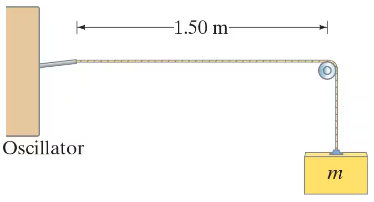
One end of a horizontal string is attached to a small-amplitude mechanical 60.0-Hz oscillator. The string’s mass per unit length is 3.9 x 10⁻ ⁴ kg/m. The string passes over a pulley, a distance ℓ = 1.50 m away, and weights are hung from this end, Fig. 15–38. What mass m must be hung from this end of the string to produce five loops of a standing wave? Assume the string at the oscillator is a node, which is nearly true.
Diagram showing a horizontal string attached to an oscillator and a mass m hanging from a pulley, 1.50 m apart.

Verified step by step guidance
1
Identify the relationship between the frequency of the oscillator, the number of loops (nodes and antinodes), and the wavelength of the standing wave. For a string with fixed ends, the wavelength is given by: λ = 2ℓ / n, where ℓ is the length of the string and n is the number of loops (n = 5 in this case).
Calculate the wavelength of the standing wave using the formula λ = 2ℓ / n. Substitute ℓ = 1.50 m and n = 5 into the equation to find λ.
Relate the wave speed v on the string to the frequency f and the wavelength λ using the wave equation: v = fλ. Substitute f = 60.0 Hz and the calculated value of λ to determine v.
Use the formula for the wave speed on a string under tension: v = √(T / μ), where T is the tension in the string and μ is the mass per unit length of the string (μ = 3.9 × 10⁻⁴ kg/m). Rearrange this equation to solve for T: T = μv².
Relate the tension T to the mass m hanging from the string using T = mg, where g is the acceleration due to gravity (approximately 9.8 m/s²). Solve for m by substituting the calculated value of T and g into the equation.

Verified video answer for a similar problem:

This video solution was recommended by our tutors as helpful for the problem above.
Video duration:
5m
Was this helpful?

Key Concepts

Here are the essential concepts you must grasp in order to answer the question correctly.

Standing Waves

Standing waves are formed when two waves of the same frequency and amplitude travel in opposite directions and interfere with each other. In a string fixed at both ends, standing waves create nodes (points of no displacement) and antinodes (points of maximum displacement). The number of loops or wavelengths that fit into the length of the string determines the frequency and the tension in the string, which is crucial for understanding wave behavior in this scenario.
Recommended video:
Guided course
07:58
Intro to Transverse Standing Waves

Tension in the String

The tension in a string affects the speed of wave propagation along it. The relationship between tension (T), mass per unit length (μ), and wave speed (v) is given by the equation v = √(T/μ). In this problem, the mass hung from the string creates tension, which is essential for determining the conditions under which standing waves can form, particularly the number of loops or wavelengths present.
Recommended video:
Guided course
04:39
Energy & Power of Waves on Strings

Fundamental Frequency and Harmonics

The fundamental frequency is the lowest frequency at which a system can oscillate, and harmonics are integer multiples of this frequency. For a string fixed at both ends, the fundamental frequency corresponds to one loop, while higher harmonics correspond to additional loops. In this case, to achieve five loops, the frequency of the oscillator must match the fifth harmonic, which is critical for calculating the required mass to achieve the desired standing wave pattern.
Recommended video:
Guided course
05:08
Circumference, Period, and Frequency in UCM