Ch. 01 - Introduction, Measurement, Estimating
Giancoli Douglas - Physics for Scientists and Engineers 5th edition
Giancoli Douglas5th editionPhysics for Scientists and EngineersISBN: 9780137488179Not the one you use?Change textbook
Chapter 1, Problem 6.80b

A plumb bob (a mass m hanging on a string) is deflected from the vertical by an angle θ due to a massive mountain nearby (Fig. 6–37).
(b) Make a rough estimate of the mass of Mt. Everest, assuming it has the shape of a cone 4000 m high and base of diameter 4000 m. Assume its mass per unit volume is 3000kg per m³.
<IMAGE>

Verified step by step guidance
1
Calculate the volume of Mt. Everest assuming it is a cone. Use the formula for the volume of a cone, which is V = \(\frac{1}{3}\) \(\pi\) r^2 h, where r is the radius of the base and h is the height of the cone. Given that the diameter of the base is 4000 m, the radius r will be half of the diameter.
Substitute the values into the volume formula. Here, r = 2000 m (half of 4000 m) and h = 4000 m.
Calculate the mass of Mt. Everest using the density formula, which is Mass = Density \(\times\) Volume. The problem states that the mass per unit volume (density) of the mountain is 3000 kg/m³.
Substitute the calculated volume and the given density into the mass formula to estimate the mass of Mt. Everest.
Reflect on the assumptions made in this calculation, such as the shape of the mountain being a perfect cone and the uniform density, and consider how these might affect the accuracy of the estimate.

Verified video answer for a similar problem:

This video solution was recommended by our tutors as helpful for the problem above.
Video duration:
8m
Was this helpful?

Key Concepts

Here are the essential concepts you must grasp in order to answer the question correctly.

Gravitational Force

Gravitational force is the attractive force between two masses, described by Newton's law of universal gravitation. It states that every point mass attracts every other point mass with a force that is directly proportional to the product of their masses and inversely proportional to the square of the distance between their centers. This concept is crucial for understanding how the mass of Mt. Everest affects the plumb bob's deflection.
Recommended video:
Guided course
05:41
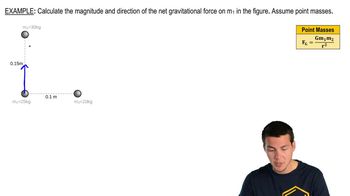
Gravitational Forces in 2D

Volume and Density

Volume is the amount of space an object occupies, while density is the mass per unit volume of a substance. To estimate the mass of Mt. Everest, we can calculate its volume assuming a conical shape and then multiply by its density. This relationship is essential for determining the mountain's mass based on its dimensions and material properties.
Recommended video:
Guided course
04:33
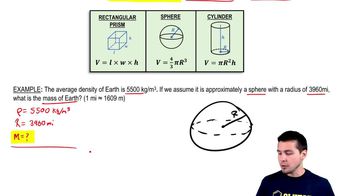
Problems with Mass, Volume, & Density

Trigonometry in Physics

Trigonometry is a branch of mathematics that deals with the relationships between the angles and sides of triangles. In this context, it helps analyze the angle θ at which the plumb bob is deflected due to the gravitational influence of Mt. Everest. Understanding trigonometric functions is vital for relating the angle of deflection to the forces acting on the bob.
Recommended video:
Guided course
3:26
Trigonometry