
(III) Determine the net resistance in Fig. 26–61 (a) between points a and c, and (b) between points a and b. Assume R' ≠ R. [Hint: Apply an emf between the two points in each case and determine currents; use symmetry at junctions.]
A voltage V is applied to n identical resistors connected in parallel. If the resistors are instead all connected in series with the applied voltage, show that the power transformed is decreased by a factor n².
Verified step by step guidance
Verified video answer for a similar problem:
Key Concepts
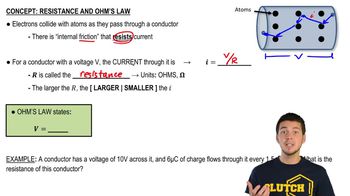
Ohm's Law
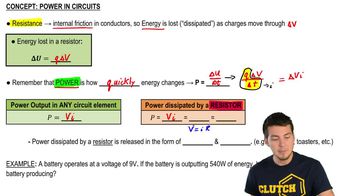
Power in Electrical Circuits
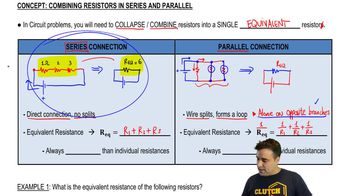
Resistor Configurations: Series vs. Parallel
(II) Suppose two batteries, with unequal emfs of 2.00 V and 3.00 V, are connected as shown in Fig. 26–63. If each internal resistance is r = 0.350Ω and R = 4.00Ω, what is the voltage across the resistor R?
(III) (a) Determine the currents I1, I2, and I3 in Fig. 26–58. Assume the internal resistance of each battery is r = 1.0 Ω.
(b) What is the terminal voltage of the 6.0-V battery?
(III) If the 25-Ω resistor in Fig. 26–59 is shorted out (resistance = 0 ), what then would be the current through the 15-Ω resistor?
(II) Determine the magnitudes and directions of the currents in each resistor shown in Fig. 26–57. The batteries have emfs of ε1 = 9.0V and ε2 = 12.0V and the resistors have values of R1 = 25 Ω, R2 = 48 Ω, and R3 = 35 Ω.
(a) Ignore internal resistance of the batteries.
(b) Assume each battery has internal resistance r = 1.0 Ω.
(II) (a) What is the potential difference between points a and d in Fig. 26–55 (similar to Fig. 26–12, Example 26–8), and (b) what is the terminal voltage of each battery?
