

Ch. 29 - Electromagnetic Induction and Faraday's Law
Giancoli Douglas - Physics for Scientists and Engineers 5th edition
Giancoli Douglas5th editionPhysics for Scientists and EngineersISBN: 9780137488179Not the one you use?Change textbook
Chapter 28, Problem 29

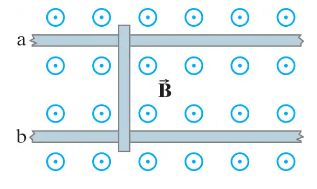
(II) A conducting rod rests on two long frictionless parallel rails in a magnetic field B\(\overrightarrow{B}\) (⊥ to the rails and rod) as in Fig. 29–53. (a) If the rails are horizontal and the rod is given an initial push, will the rod travel at constant speed even though a magnetic field is present? (b) Suppose at t = 0, when the rod has speed v = v0, the two rails are connected electrically by a wire from point a to point b. Assuming the rod has resistance R and the rails have negligible resistance, determine the speed of the rod as a function of time. Discuss your answer.

Verified step by step guidance
1
Step 1: Analyze the situation described in part (a). The rod is moving on frictionless rails in the presence of a magnetic field that is perpendicular to the plane of the rails and the rod. According to Faraday's Law of Electromagnetic Induction, the motion of the rod through the magnetic field will induce an electromotive force (EMF) in the rod. This EMF will generate a current in the circuit formed by the rod, rails, and connecting wire. The interaction of this current with the magnetic field will produce a magnetic force (Lorentz force) that opposes the motion of the rod (Lenz's Law). Therefore, the rod will not travel at a constant speed; it will decelerate due to this opposing force.
Step 2: For part (b), start by determining the induced EMF in the rod as it moves through the magnetic field. The EMF (ε) is given by Faraday's Law: ε=Blv, where B is the magnetic field strength, l is the length of the rod, and v is the velocity of the rod.
Step 3: Use Ohm's Law to find the current (I) in the circuit. The current is given by I=εR, where R is the resistance of the rod. Substituting the expression for ε, we get I=BlvR.
Step 4: Determine the magnetic force acting on the rod due to the current. The magnetic force (F) is given by F=IlB. Substituting the expression for I, we get F=BlvRlB, which simplifies to F=BlvR.
Step 5: Apply Newton's Second Law to relate the deceleration of the rod to the magnetic force. The net force on the rod is F=mdvdt, where m is the mass of the rod. Equating this to the magnetic force, we get mdvdt=BlvR. Solving this differential equation will yield the velocity of the rod as a function of time, v(t). The solution will show that the velocity decreases exponentially over time due to the opposing magnetic force.

Verified video answer for a similar problem:

This video solution was recommended by our tutors as helpful for the problem above.
Video duration:
9m
Was this helpful?

Key Concepts

Here are the essential concepts you must grasp in order to answer the question correctly.

Electromagnetic Induction

Electromagnetic induction is the process by which a changing magnetic field within a closed loop induces an electromotive force (EMF) in the loop. This principle is crucial for understanding how the motion of the conducting rod in the magnetic field generates an induced current, which in turn affects the rod's motion due to the Lorentz force acting on it.
Recommended video:
Guided course
05:42
Introduction to Induction

Lorentz Force

The Lorentz force is the force experienced by a charged particle moving through a magnetic field. It is given by the equation F = q(v × B), where F is the force, q is the charge, v is the velocity of the particle, and B is the magnetic field. In the context of the rod, this force acts perpendicular to both the direction of the current and the magnetic field, influencing the rod's acceleration and speed.
Recommended video:
Guided course
13:39
Lorentz Transformations of Velocity

Resistance and Ohm's Law

Resistance is a measure of the opposition to the flow of electric current in a conductor, described by Ohm's Law (V = IR), where V is voltage, I is current, and R is resistance. In this scenario, the rod's resistance affects the induced current when the rails are connected, which in turn influences the speed of the rod over time as it interacts with the magnetic field.
Recommended video:
Guided course
03:07
Resistance and Ohm's Law