
Textbook Question
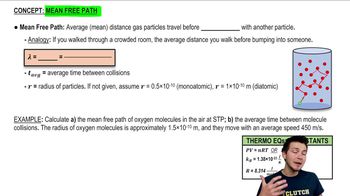
At about what pressure would the mean free path of air molecules be equal to the diameter of air molecules, ≈ 3 x 10⁻¹⁰ m? Assume T = 20° C.
1385
views

 Verified step by step guidance
 08:20
08:20 08:20
08:20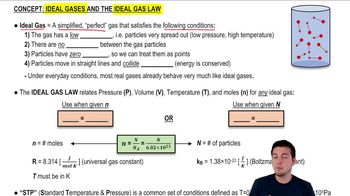 07:21
07:21At about what pressure would the mean free path of air molecules be equal to the diameter of air molecules, ≈ 3 x 10⁻¹⁰ m? Assume T = 20° C.
Water is in which phase when the pressure is 0.01 atm and the temperature is 90°C?
A gas consisting of 14,500 molecules, each of mass 2.00 x 10⁻²⁶ kg, has the following distribution of speeds, which crudely mimics the Maxwell distribution. Determine vᵣₘₛ for this distribution of speeds.
At about what pressure would the mean free path of air molecules be 0.30 m? Assume T = 20° C.
For what range of pressures and temperatures can CO₂ be a liquid? Refer to Fig. 18-6.
Estimate the time needed for a glycine molecule (see Table 18–3) to diffuse a distance of 25μm in water at 20°C if its concentration varies over that distance from 1.00 mol/m³ to 0.50 mol/m³. Compare this “speed” to its rms (thermal) speed. The molecular mass of glycine is about 75 u.