"(II) A rectangular loop of wire is placed next to a straight wire, as shown in Fig. 28–40. There is a dc current of 3.5 A in both wires. Determine the magnitude and direction of the net force on the loop.
Ch. 28 - Sources of Magnetic Field
Giancoli Douglas5th editionPhysics for Scientists and EngineersISBN: 9780137488179Not the one you use?Change textbook
Chapter 27, Problem 7
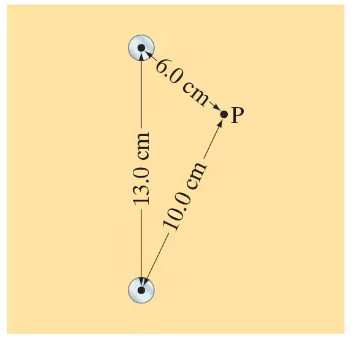
(II) Two long thin parallel wires 13.0 cm apart carry 25-A currents in the same direction. Determine the magnetic field vector at a point 10.0 cm from one wire and 6.0 cm from the other (Fig. 28–37). [Hint: You could try using the law of cosines, Appendix A.]

Verified step by step guidance1
Step 1: Understand the problem. Two parallel wires carry currents of 25 A in the same direction. The goal is to find the net magnetic field vector at a point that is 10.0 cm from one wire and 6.0 cm from the other. The magnetic field due to a current-carrying wire is given by the Biot-Savart law or Ampere's law, specifically: B = (μ₀ * I) / (2π * r), where μ₀ is the permeability of free space, I is the current, and r is the distance from the wire.
Step 2: Calculate the magnetic field magnitude due to each wire at the given point. For the first wire, use the formula B₁ = (μ₀ * I) / (2π * r₁), where r₁ = 10.0 cm = 0.1 m. For the second wire, use B₂ = (μ₀ * I) / (2π * r₂), where r₂ = 6.0 cm = 0.06 m. These fields will have different magnitudes because the distances r₁ and r₂ are different.
Step 3: Determine the direction of the magnetic fields. Use the right-hand rule: point your thumb in the direction of the current, and your curled fingers show the direction of the magnetic field. Since the currents are in the same direction, the magnetic fields at the point of interest will form circular patterns around each wire. Analyze the geometry to determine the angle between the two magnetic field vectors.
Step 4: Use vector addition to find the net magnetic field. The two magnetic fields, B₁ and B₂, are not aligned, so you need to resolve them into components. Use trigonometry to find the x- and y-components of each field. For example, if θ is the angle between the wires and the point, the components of B₁ are B₁x = B₁ * cos(θ₁) and B₁y = B₁ * sin(θ₁). Similarly, resolve B₂ into its components.
Step 5: Combine the components to find the net magnetic field. Add the x-components and y-components separately: B_net_x = B₁x + B₂x and B_net_y = B₁y + B₂y. Then, calculate the magnitude of the net field using the Pythagorean theorem: B_net = √(B_net_x² + B_net_y²). Finally, determine the direction of the net field using the arctangent function: θ_net = arctan(B_net_y / B_net_x).

Verified video answer for a similar problem:
This video solution was recommended by our tutors as helpful for the problem above.
Video duration:
14mWas this helpful?
Key Concepts
Here are the essential concepts you must grasp in order to answer the question correctly.
Magnetic Field Due to a Current-Carrying Wire
A long straight wire carrying an electric current generates a magnetic field around it. The strength and direction of this magnetic field can be determined using the right-hand rule and the formula B = (μ₀/4π) * (2I/r), where B is the magnetic field, I is the current, r is the distance from the wire, and μ₀ is the permeability of free space.
Recommended video:
Guided course
Magnetic Force on Current-Carrying Wire
Superposition Principle
The superposition principle states that the total magnetic field at a point due to multiple sources is the vector sum of the magnetic fields produced by each source individually. In this case, the magnetic fields from both wires must be calculated separately and then combined to find the resultant magnetic field at the specified point.
Recommended video:
Guided course
Superposition of Sinusoidal Wave Functions
Law of Cosines
The law of cosines relates the lengths of the sides of a triangle to the cosine of one of its angles. It is useful in determining distances and angles in problems involving multiple vectors, such as calculating the resultant magnetic field from two wires at a specific point. The formula is c² = a² + b² - 2ab * cos(θ), where c is the side opposite the angle θ.
Recommended video:
Guided course
Gauss' Law
Related Practice
Textbook Question
1101
views
Textbook Question
(II) Two long straight wires each carry a dc current I out of the page toward the viewer, Fig. 28–38. Indicate, with appropriate arrows, the direction of at each of the points 1 to 6 in the plane of the page. State if the field is zero at any of the points.
720
views
Textbook Question
(II) In Fig. 28–36, a long straight wire carries current I out of the page toward you. Indicate, with appropriate arrows, the direction and (relative) magnitude of at each of the points C, D, and E in the plane of the page.
752
views
Textbook Question
(II) Let two long parallel wires, a distance d apart, carry equal dc currents I in the same direction. One wire is at 𝓍 = 0, the other at 𝓍 = d, Fig. 28–41. Determine along the 𝓍 axis between the wires as a function of 𝓍.
830
views